
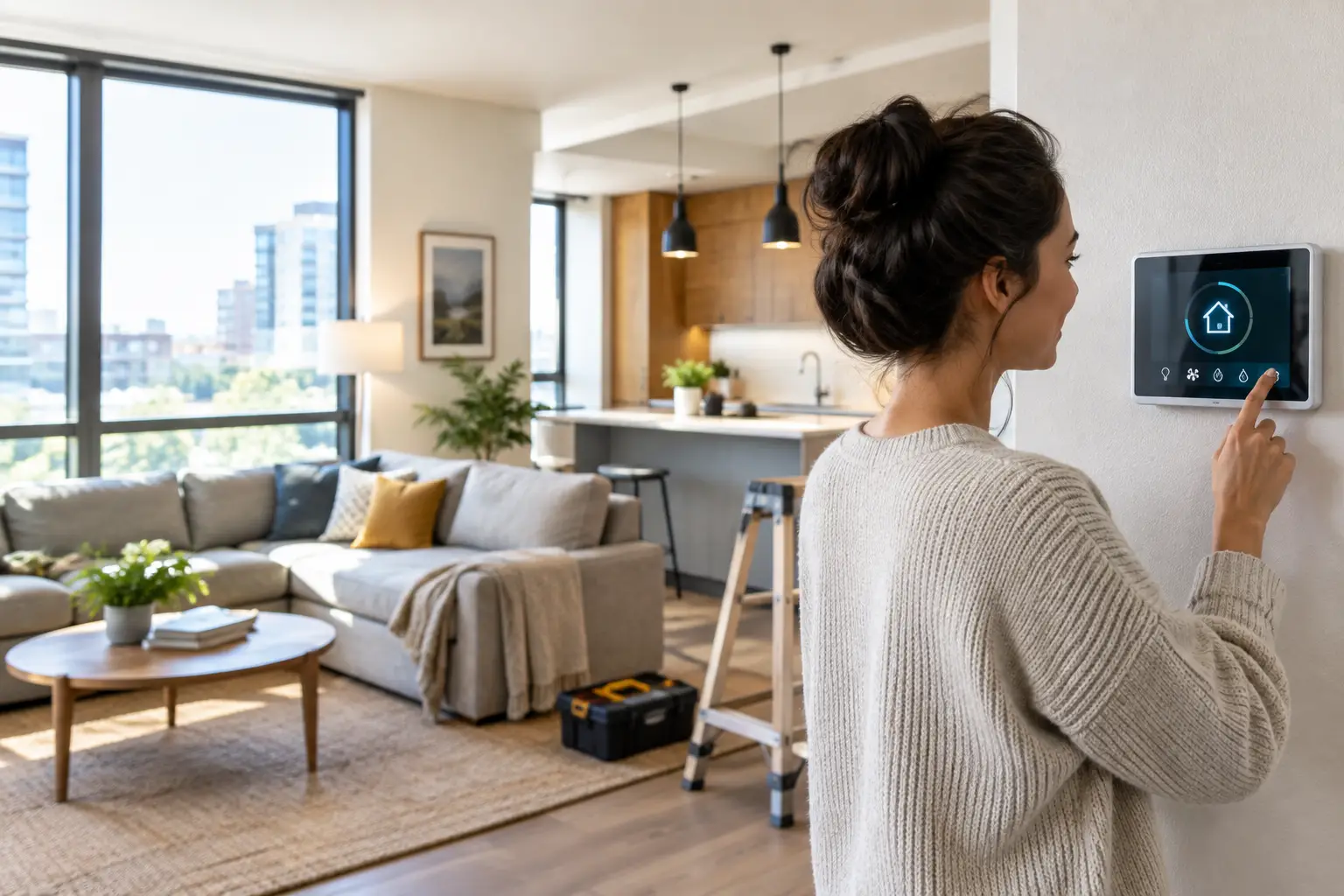
A smart apartment retrofit allows homeowners in Dubai to upgrade their existing apartments with modern home automation without necessarily requiring major renovation work. From smart lighting and intelligent AC control to motorized curtains, smart locks, and security systems, retrofit solutions can improve comfort, convenience, and energy efficiency while making the most of existing electrical infrastructure.
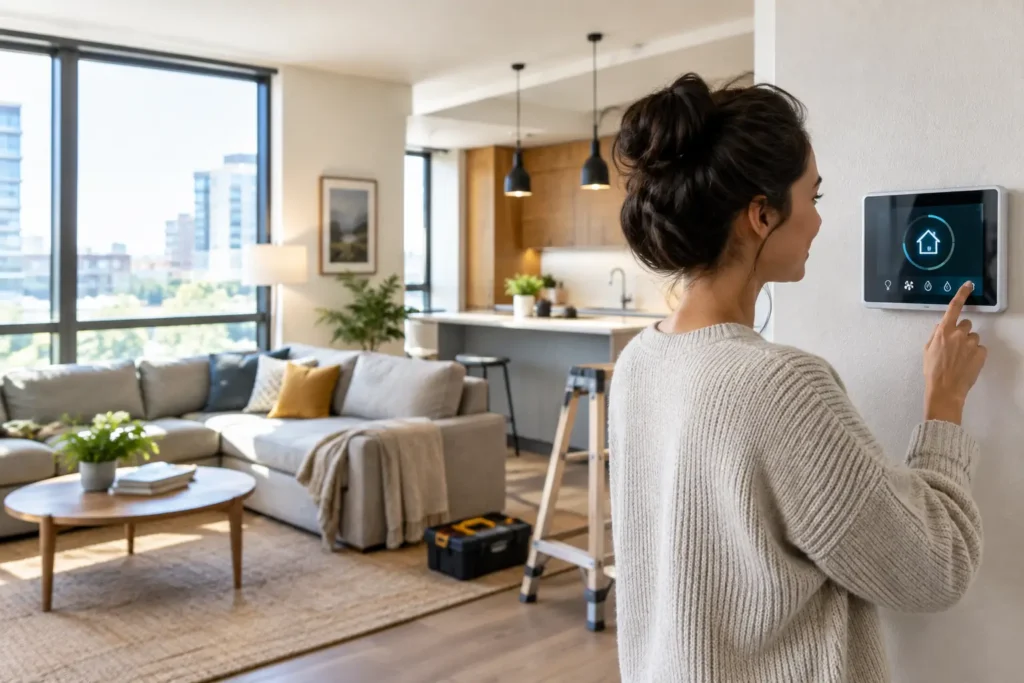
For a Dubai apartment owner, the objective is usually simple: make the property feel more comfortable, secure, and refined without tearing apart finished interiors. The right retrofit connects the systems residents use every day into one intelligent system, tailored to the apartment’s layout, lifestyle, and existing infrastructure.
How a Smart Apartment Retrofit Works in Dubai
Consider a three-bedroom, 2,000-square-foot apartment with completed finishes, centralized air conditioning, motorized curtain tracks in the living room, an existing video intercom, and a mix of decorative lighting and downlights. The owner lives there most of the year but also travels frequently, so remote access and dependable security matter as much as convenience.
The challenge is common in premium apartments: the property has quality individual systems, but they operate separately. Lights are controlled by conventional switches, AC is adjusted through wall thermostats, curtains have their own remote, and the entrance relies on keys or building access. Nothing is technically wrong, yet the home does not operate as one coordinated environment.
A retrofit should improve this without replacing equipment that still performs well. That is where professional system design matters. Some devices can be integrated directly, while others may require a discreet control module, compatible smart driver, or replacement switch. The best answer depends on the wiring available, the building management rules, and the owner’s expectations.
Smart Apartment Retrofit Example: What Changes
In this example, the apartment receives a centralized control platform that brings lighting, climate, curtains, entry access, cameras, and selected entertainment functions into a single app and voice-enabled interface. Physical keypads remain in the most useful locations, including the entrance, living room, and primary bedroom. A premium smart home should not force residents to reach for a phone to turn on a light.
Lighting that responds to how rooms are used
The living and dining areas are divided into purposeful lighting scenes rather than a single on-off command. “Welcome Home” activates warm ambient lighting, illuminates the entry route, lowers the AC to a comfortable setting, and opens the living-room curtains if the time of day allows. “Dinner” dims general lighting while maintaining focused light over the table. “Movie” lowers shades, turns off decorative lights, and leaves a soft pathway light active.
In bedrooms, bedside keypads provide simple commands for lights, curtains, and a whole-apartment “Good Night” scene. When activated, this scene turns off nonessential lights, closes curtains, adjusts the temperature, and confirms that the entry door is locked.
Not every lighting circuit needs automation. In a guest bathroom or utility room, an occupancy sensor may offer better value than a costly keypad. In a rarely used storage area, a standard switch may be entirely appropriate. A tailored retrofit prioritizes the spaces where automation improves daily life.
Climate control built around comfort and energy use
Air conditioning is one of the most valuable elements of an apartment retrofit in the UAE. Instead of cooling every room to the same setting throughout the day, compatible smart thermostats or AC interface modules can provide zone-based control.
In this scenario, the living area is pre-cooled before the owner arrives home, while unused bedrooms remain at an energy-conscious setting. When balcony doors or selected windows are left open, the relevant cooling zone can be paused through contact sensors. The owner can also check temperature and AC status remotely when traveling.
There are limits. A centralized chilled-water system, fan coil configuration, or building-managed thermostat may affect what can be controlled and how precisely. A site assessment identifies these constraints before equipment is specified, preventing promises that the apartment’s mechanical system cannot support.
Curtains and shades that protect comfort and privacy
Motorized curtains are integrated into scenes and schedules. During the afternoon, they can close in sun-exposed rooms to reduce glare and limit heat gain. In the evening, a privacy command closes curtains throughout the apartment while maintaining a welcoming lighting scene.
Where curtain tracks are not motorized, the retrofit may include motors compatible with the track and fabric weight. This requires careful measurement and installation. A heavy blackout curtain, a curved track, or a concealed pocket can change the solution and the budget.
Security and access under one view
At the entrance, a smart lock provides controlled access through a secure code, app credential, or approved temporary code for household staff. The owner can receive a notification when the door is unlocked and review access activity without sharing a physical key.
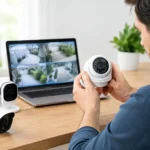
A video door station or integrated building intercom can allow the resident to see and speak with visitors from the app. Discreet cameras may cover the entrance or key internal areas when the apartment is vacant. Privacy should be considered from the start: camera locations, user permissions, notification settings, and recording requirements should be agreed before installation.
The “Away” scene becomes more useful than a simple switch-off command. It turns off selected lights and entertainment devices, closes curtains, sets AC to an efficient mode, arms relevant alerts, and sends a confirmation that the property has entered its away state.
Why Wireless and Wired Choices Matter
For a completed apartment, wireless automation is often the practical starting point. It can minimize disruption to finished walls, reduce installation time, and allow smart switches, sensors, and controllers to be placed where they are most effective. High-quality wireless systems are not improvised consumer gadgets. When professionally designed, they use reliable protocols, proper device placement, and a stable network strategy.
Wired control may still be the stronger choice in selected areas. If renovation work is already planned, wiring can provide dedicated communication paths for lighting panels, keypads, shades, and AV equipment. It is especially useful where a large number of circuits must be controlled or where long-term expansion is a priority.
Many apartments benefit from a hybrid design. For example, hardwired controllers may manage major lighting and curtain systems in the living area, while wireless sensors and selected keypads serve bedrooms or spaces where opening walls would be unnecessary. The technology architecture should follow the property, not the other way around.
The Retrofit Process Behind a Clean Result
A successful apartment retrofit is as much a coordination project as a technology project. The equipment is only one part of the outcome.
At the consultation stage, the integrator reviews the apartment layout, existing switches, lighting circuits, AC system, network coverage, curtains, entry arrangement, and building restrictions. The conversation should also cover how the owner actually lives: whether staff require access, whether the apartment is rented at times, which rooms are used daily, and what should happen when the owner is away.
The quotation and design stage converts those needs into a clear scope. It should identify what will be controlled, which existing equipment will remain, where keypads and sensors will sit, and what is excluded. This is the point to make sensible budget decisions. A full-home audio system may be desirable, but lighting, climate, entry, and security may deliver greater day-to-day value first.
During installation, professional teams protect finishes, label equipment, manage any required low-voltage work, and test each device before handover. Programming is not a final afterthought. Scenes need to be adjusted for real routines, such as the preferred evening light level or the correct time for AC pre-cooling.
At handover, the owner should receive straightforward guidance on physical controls, the app, voice commands if included, guest access, and what to do if internet service is interrupted. Esmartech approaches this as a complete project, from consultation and system design through installation, testing, and user guidance.
What This Retrofit Delivers
The finished apartment still looks like a carefully designed residence, not a technology showroom. Controls are discreet, rooms remain easy to use for family and guests, and the owner has visibility whether at home or abroad.
The practical gains are felt in small routines: one command when leaving, the right temperature before arrival, lights that support each activity, and controlled access without key handovers. The property also becomes easier to manage as needs change. Additional sensors, rooms, or automation functions can be added later if the original platform and network were selected with growth in mind.
A smart apartment retrofit works best when it removes decisions rather than adding menus. Start with the routines you want the home to handle quietly, then build the system around them.


Leave a comment