
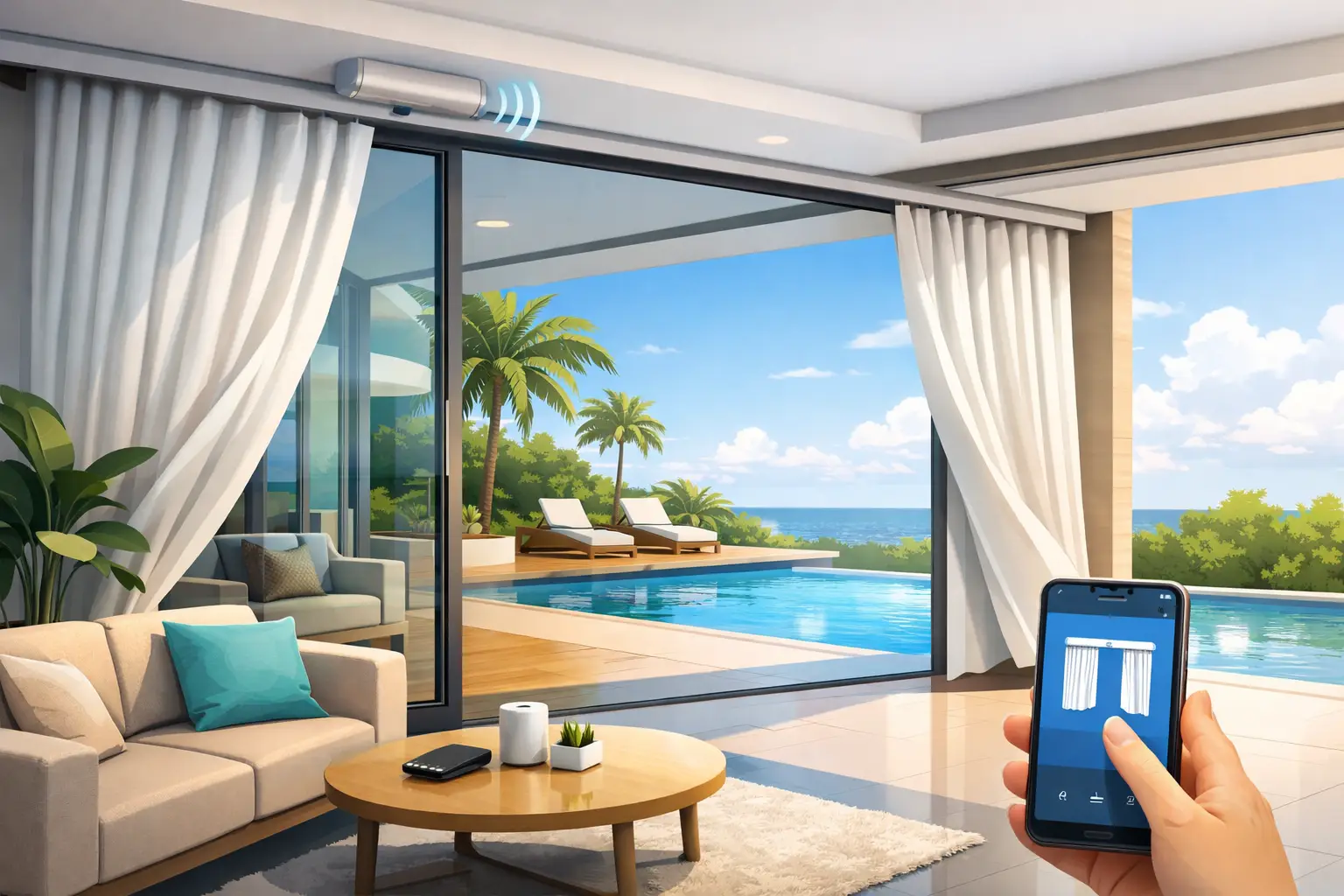
The afternoon sun can turn a glass-fronted villa living room into the warmest room in the house long before anyone reaches for a thermostat. Automated curtains for villas give homeowners a more considered response: shades and drapes can react to time, light levels, room temperature, or a single command from a wall keypad, phone, or voice assistant.
For a luxury property, this is not simply about replacing a curtain pull with an app. Properly designed motorized window treatments protect interiors, improve privacy, support climate control, and make large or hard-to-reach windows effortless to manage. The difference lies in treating curtains as part of one intelligent system rather than as an isolated gadget.
Why Automated Curtains for Villas Are Worth Considering
Villas often have features that make manual curtain operation inconvenient: double-height glazing, wide sliding doors, multiple formal rooms, and bedrooms with several windows. Opening and closing each treatment by hand is manageable for one room. Across an entire property, it quickly becomes a daily task that is easy to postpone.
Automation brings consistency. Bedroom blackout curtains can open gradually at a preferred wake-up time. Sheer curtains in a family room can close when sunlight becomes harsh, while maintaining a softer level of natural light. In the evening, selected curtains can close as part of a “Good Night” scene that also adjusts lighting, air conditioning, and security settings.
Privacy is equally valuable. For villas overlooking neighboring homes, gardens, roads, or waterfront areas, scheduled curtains create a more private interior without relying on someone to remember every window. When the home is unoccupied, programmed movement can also make the property appear attended, although it should support rather than replace a complete security strategy.
There is an energy benefit as well. Direct solar gain through large windows can increase cooling demand, particularly in Dubai’s hotter months. Closing the right curtains or blinds before peak sun reaches a façade reduces glare and heat entering the room. The result depends on glass specification, curtain fabric, orientation, and the overall HVAC design, but window shading is a practical part of a wider energy-management approach.
What a Well-Designed Villa Curtain System Includes
The visible fabric is only one element. Behind it are the track, motor, power arrangement, controls, and programming that determine how reliably the system works over time. A professional design begins with the windows themselves, not with a catalog of devices.
Motorized tracks matched to the window treatment
A lightweight sheer curtain and a full-height, lined blackout drape require different motors and track specifications. The track must be correctly sized for the curtain weight, width, stacking space, and opening style. Ripple-fold, pinch-pleat, center-opening, and one-way opening curtains each affect the final layout.
For recessed pockets, the planning needs to happen early. Ceiling details, access panels, curtain drops, and the location of the motor all need coordination with the interior designer and contractor. Retrofitting is possible in many completed villas, but early planning creates a cleaner result and preserves more design options.
Control that works without becoming complicated
The best control method is usually more than one method. A homeowner may want a bedside keypad for immediate use, a wall switch in the living area, app control while away, and voice control when carrying something through the room. Every option should be simple enough for family members, guests, and household staff to understand.
Scenes are where the system becomes especially useful. A “Morning” scene might raise bedroom curtains, open selected ground-floor sheers, and set lighting to a comfortable level. An “Entertain” scene can close privacy curtains around outdoor-facing rooms while leaving the dining area softly illuminated. These settings should reflect how the household actually lives rather than relying on generic presets.
Wired or wireless architecture
Both wired and wireless systems can be suitable for automated curtains. New builds and major renovations are often ideal for wired infrastructure because power and low-voltage cabling can be planned before finishes are complete. It provides a structured foundation for a larger integrated villa system.
Wireless solutions can be a strong option for occupied homes where extensive construction is not desirable. They can reduce disruption and allow targeted upgrades in selected rooms. However, wireless does not mean design-free. Signal coverage, power access, motor placement, battery maintenance where applicable, and integration requirements should all be assessed on site.
The right choice depends on the property, scope of work, and future plans. A villa owner adding curtains to two bedrooms has different needs from a developer preparing a multi-room smart villa with lighting, climate, access control, CCTV, and entertainment under one platform.
Choosing Fabrics for Privacy, Light, and Performance
Automation cannot compensate for the wrong fabric selection. A sheer curtain may soften daylight beautifully but will not provide nighttime privacy on its own. A blackout lining may be essential in bedrooms, media rooms, or spaces affected by exterior lighting. In living rooms, pairing a sheer layer with a heavier drape often gives the most flexible result.
Consider the direction each room faces. West-facing rooms may need greater solar control in the afternoon, while east-facing bedrooms may benefit from programmed blackout curtains that open after sunrise. Fabric color, density, and lining all influence light filtration and heat management.
Motorized blinds may also be more appropriate than curtains in certain locations. Roller shades suit minimal interiors and can fit neatly within window recesses. Roman blinds offer a softer look for smaller windows. For very large glazed areas, a combination of blinds and decorative curtains may provide the best balance of performance and design. The decision should follow the architecture and interior scheme, not a one-size-fits-all preference.
How Curtain Automation Connects With the Rest of the Home
Standalone remote-controlled curtains offer convenience, but integration creates better day-to-day control. When curtains connect with lighting, climate, sensors, and security, the home can respond in coordinated ways.
For example, a façade exposed to strong afternoon sun can trigger shading while the climate system adjusts gradually rather than responding only after the room overheats. A door lock or alarm mode can activate an Away scene, closing designated curtains and switching off unnecessary lighting. A cinema scene can lower blackout shades, close drapes, dim lights, and start the entertainment system from one command.
This approach also keeps the interface simpler. Instead of separate remotes and apps for every room, residents can manage key functions through one intelligent system. The goal is not to automate every movement. It is to make recurring routines easier while leaving manual control available whenever it is preferred.
A Practical Installation Process
Reliable automated curtains begin with a site consultation. The installation team should measure openings, review existing finishes, identify power availability, assess Wi-Fi or wired network conditions, and understand the homeowner’s expectations for privacy, scheduling, and system integration.
After that assessment, the proposed system should clearly define the selected tracks or shades, control options, automation scenes, and installation scope. This is the stage to resolve details such as whether curtains need to operate during a power interruption, how wall controls will look, and whether future rooms should be prepared for expansion.
Installation should be coordinated carefully with ceiling work, painting, window treatment fabrication, and furniture delivery. Once motors and controls are installed, programming and testing are essential. Each curtain should travel smoothly, stop accurately, respond to its assigned controls, and operate correctly within scenes. At handover, residents and staff should receive straightforward guidance on daily operation and what to do if adjustments are needed.
Esmartech manages this process from consultation and system design through installation, testing, and user handover, helping villa owners avoid the gaps that can occur when window treatments and automation are handled as unrelated trades.
Questions Villa Owners Often Ask
Can automated curtains still be operated manually?
Yes. Most systems include wall controls, app controls, and often manual operation procedures. The exact method depends on the motor and track selected. A good design makes normal operation easy even for someone who does not use the app.
Do motorized curtains require ongoing maintenance?
They need relatively little maintenance when the track, motor, and fabric weight are correctly specified. Curtains should be kept from snagging on furniture or window handles, and the track should remain clear. Battery-powered systems may require periodic battery replacement or charging, while wired systems avoid that routine task.
Can they be added to a finished villa?
In many cases, yes. Wireless controls and carefully planned power solutions can make retrofit projects practical. The feasibility and finish quality depend on the ceiling design, access, window treatment choice, and the desired level of integration.
A villa should feel composed from the moment the sun rises until the last room is secured at night. When curtains are designed around the home, its architecture, and its routines, they become one of the quietest ways to make that experience more comfortable.
Leave a comment