
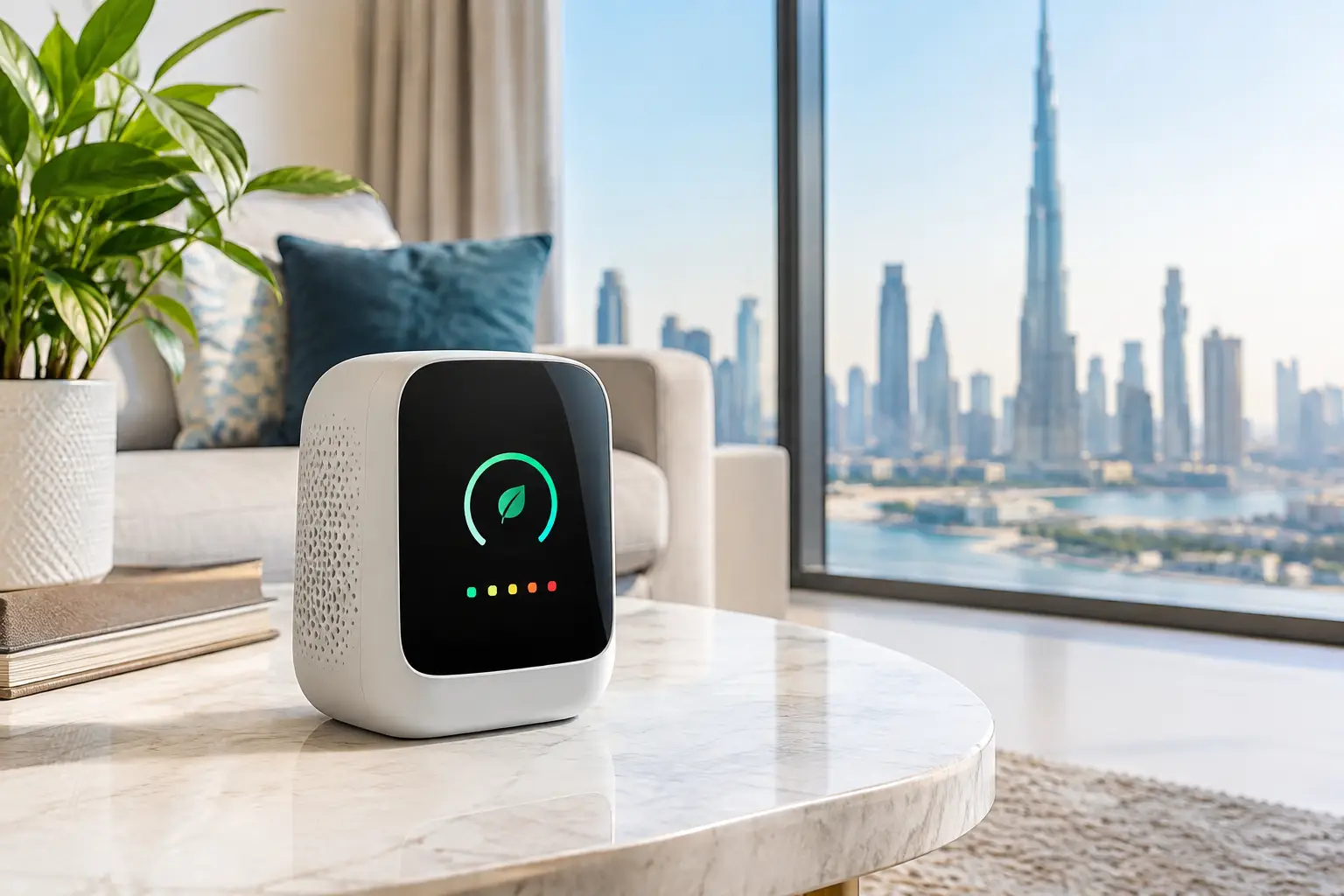
A beautiful villa can feel perfectly cooled while its indoor air tells a different story. Fine dust enters during busy outdoor periods, cooking releases particles and gases, and closed windows can allow carbon dioxide levels to rise quietly through the evening. A smart air quality monitor review should therefore look beyond a polished screen or an attractive mobile app. The right device should help your property respond intelligently to conditions that affect comfort, health, and energy use.
For premium homes, apartments, hospitality spaces, and offices, the strongest choice is rarely a monitor that simply sends alerts. It is a monitor that becomes part of one intelligent system – providing useful data and triggering considered action through climate control, ventilation, purification, and automation scenes.
What a Smart Air Quality Monitor Should Measure
Not every device measures the same pollutants, and more readings do not automatically mean better decisions. Start with the conditions that are most relevant to how your space is used.
PM2.5 and particulate matter are among the most valuable measurements. These microscopic particles can come from outdoor dust, traffic, construction activity, cooking, candles, and cleaning activities. In the UAE, a monitor with dependable particulate sensing is particularly useful because outdoor conditions can change quickly and affect indoor comfort even in well-sealed properties.
Carbon dioxide, or CO2, is a practical indicator of ventilation in occupied rooms. It does not measure all air pollutants, but rising CO2 can signal that a bedroom, meeting room, restaurant area, or home cinema needs more fresh-air exchange. This is especially relevant in spaces designed for privacy, quiet, and strong air conditioning, where windows remain closed for long periods.
Volatile organic compounds, commonly shown as VOCs or TVOCs, may be released by paints, furnishings, cleaning products, fragrances, and cooking. These readings are useful for identifying changes after renovation or during high-use periods. However, VOC sensors often provide a broad trend rather than a laboratory-grade identification of a specific chemical. Treat them as a prompt to investigate and improve ventilation, not as a diagnosis.
Temperature and humidity complete the picture. They are essential for comfort and can influence how a room feels even when the thermostat appears correct. High humidity may also affect condensation risk and the performance of certain finishes, while very dry air can be uncomfortable for occupants.
A device that claims to measure every possible pollutant is not necessarily the best investment. For most residences and commercial interiors, accurate PM2.5, CO2, VOC, temperature, and humidity data provide a useful foundation.
Smart Air Quality Monitor Review: Features That Matter
A monitor earns its place in a well-designed property when the information is clear, the sensors are credible, and the system can act on the results. This is where a basic consumer device and a professionally planned solution begin to differ.
Reliable sensing and understandable trends
Look for a monitor that shows both current conditions and historical trends. A single elevated reading can be caused by cooking dinner or opening a balcony door. Trends reveal whether a room has a recurring ventilation issue, whether a purifier is making a measurable difference, or whether air quality changes at particular times of day.
The display should be easy to understand at a glance, but the app or central control platform should allow deeper review when needed. A property manager does not need a technical dashboard full of unexplained numbers. They need clear information: which area needs attention, what changed, and whether the system has responded.
Sensor quality also matters more than headline feature counts. Low-cost sensors may drift over time, react slowly, or show broad estimates that are difficult to use confidently. Select established equipment, confirm maintenance requirements, and ask whether the device supports calibration or replacement where appropriate.
Useful automation, not constant notifications
The most valuable feature is integration. A standalone monitor can tell you that air quality has declined. An integrated monitor can support an automated response based on rules designed for your property.
For example, when PM2.5 rises in a living area, the system may activate an air purifier, adjust ventilation if the property has suitable mechanical fresh-air control, and send a discreet notification only if conditions remain elevated. If CO2 rises in a home office or meeting room, ventilation can increase before occupants notice the room becoming stale. When outdoor dust levels are high, smart curtains and climate strategies may be coordinated to support indoor comfort without wasting energy.
These automations must be designed carefully. Running ventilation at full output whenever a sensor changes can increase noise, energy consumption, and wear on equipment. The better approach uses sensible thresholds, time delays, occupancy conditions, and manual override options. Technology should make the property feel effortless, not overly reactive.
Room-by-room coverage
One monitor in a large villa cannot describe the air quality everywhere. Kitchens, bedrooms, nurseries, gyms, offices, and formal living rooms each have different patterns of use. A kitchen may experience brief particle spikes, while a closed bedroom may gradually develop high CO2 overnight.
Place monitors where people spend meaningful time and where conditions are likely to vary. For many homes, that means the primary living area and master bedroom first, then additional units for children’s rooms, home offices, gyms, and entertainment spaces. Hotels and offices may require a more deliberate zone-by-zone plan, especially where guest comfort and staff productivity are priorities.
Avoid placing a monitor directly beside supply vents, windows, air purifiers, cooking appliances, or bathrooms unless that specific source is being studied. These positions can distort readings and lead to unnecessary automation behavior.
The Trade-Off Between Portable and Integrated Monitors
Portable Wi-Fi monitors are appealing because they are easy to purchase and move between rooms. They can be a sensible starting point for an apartment resident who wants visibility into a single space. Many provide good app-based data and basic smart-home connections.
Their limitations become apparent in larger or more refined projects. They often depend on multiple separate apps, need visible charging cables, and may have limited support for wired power, centralized control, or commercial-grade deployment. If the Wi-Fi network changes, devices may require individual reconnection. For a property with several rooms and multiple systems, that can create complexity rather than reduce it.
Integrated monitors are best for new builds, major renovations, luxury villas, hotels, and offices where air quality is part of the wider property strategy. Depending on the selected platform, they can be installed discreetly, powered reliably, linked to climate equipment, and controlled from the same interface as lighting, curtains, security, and AV. The upfront planning is greater, but so is the long-term consistency.
It depends on the property and the desired outcome. A portable unit is suitable for awareness. A designed, integrated solution is suitable for management.
Questions to Ask Before You Buy
Before selecting a monitor, ask what will happen after it detects a problem. If the answer is simply that someone will check an app, a basic device may be enough. If the goal is to protect sleep quality, manage ventilation across several rooms, support guest comfort, or coordinate purifiers and AC systems, the monitor should be selected alongside the systems it will control.
Also consider connectivity and privacy. Cloud-based apps offer convenient remote access but may require ongoing accounts and internet service. Local or professionally integrated control can offer more dependable operation and a cleaner user experience, although available features vary by platform. For commercial properties, clarify who can view the data, who receives alerts, and how system permissions are managed.
Finally, do not confuse an air quality monitor with a safety device. It does not replace smoke alarms, heat detectors, carbon monoxide alarms where required, or professionally specified life-safety systems. Each has a distinct role in protecting the property.
Professional Design Makes the Data Useful
A well-installed monitoring solution begins with a site consultation. The goal is to understand the property’s layout, HVAC configuration, occupancy patterns, existing automation, and the spaces that matter most. From there, the system can be tailored to your space and needs, with clear recommendations on sensor locations, control logic, and future expansion.
Esmartech approaches smart property technology as a complete project rather than a collection of devices. Following consultation and a clear quotation, the team can coordinate installation, programming, testing, and handover so that air quality monitoring works naturally within the wider control system. The result is a cleaner experience for homeowners and a more manageable operation for commercial and hospitality teams.
The best monitor is not the one that creates the most alerts. It is the one that helps your property quietly maintain the conditions people expect: fresh air, balanced comfort, and intelligent control that is there when needed and invisible when it is not.

Leave a comment