
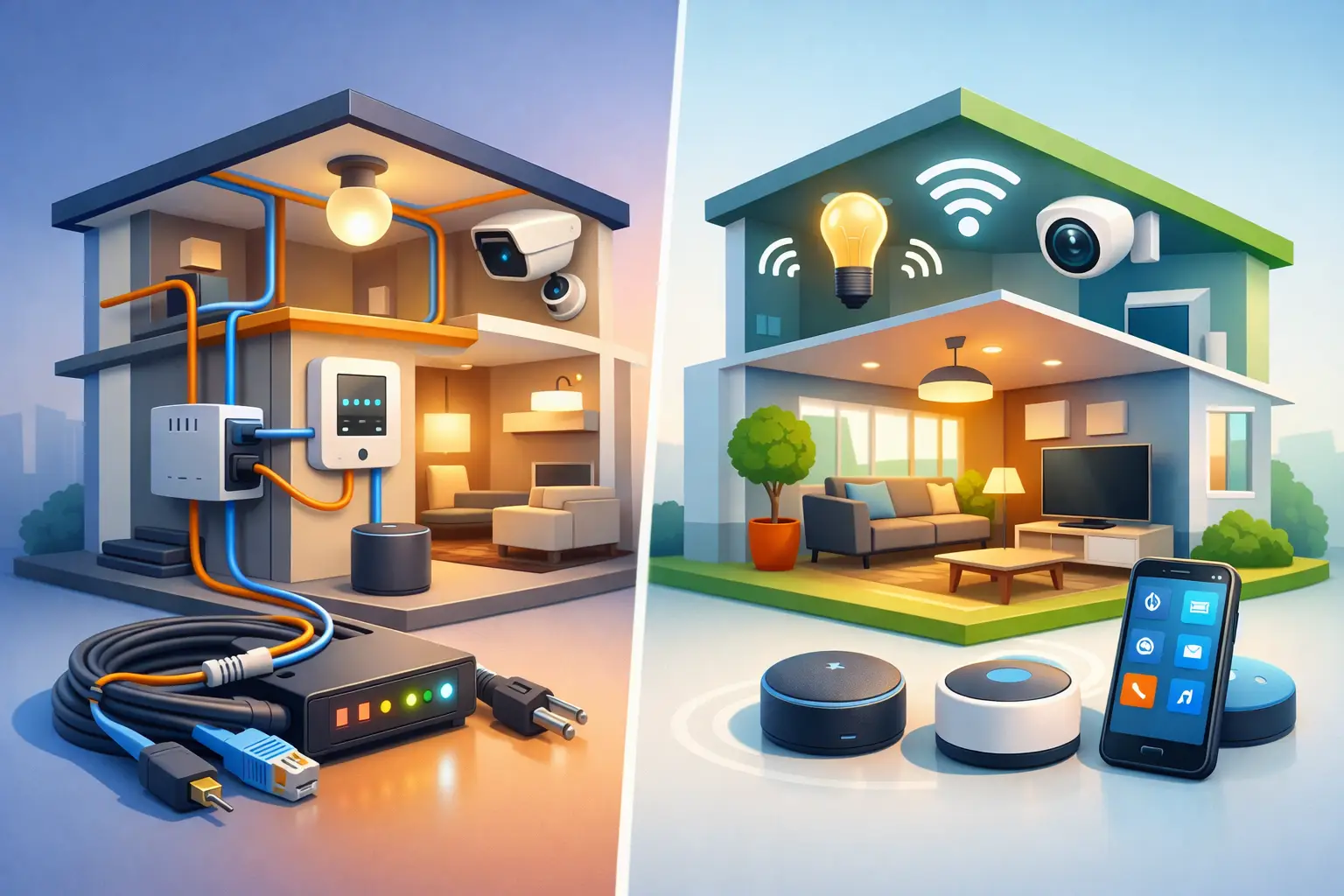
A villa may have motorized curtains in every room, climate zones across multiple floors, discreet security cameras, garden lighting, and a cinema that needs to work at the touch of one button. An apartment may need only lighting, AC control, and a smart lock. That is why wired vs wireless home automation is not a simple question of old technology versus new. It is a design decision that affects reliability, installation work, future upgrades, and the everyday experience of everyone using the property.
For a luxury new build, a wired backbone often creates the strongest long-term foundation. For a finished apartment or an occupied villa, wireless control can deliver meaningful upgrades without opening walls. Many of the best projects use both, with each method assigned to the jobs it performs best.
Wired vs Wireless Home Automation: The Core Difference
A wired automation system uses dedicated low-voltage cabling to connect key devices to a central control panel or network infrastructure. During construction or major renovation, cables can be run behind walls and ceilings to lighting modules, keypads, sensors, curtain motors, thermostats, door stations, and AV equipment. The result is a purpose-built system designed around the property.
Wireless automation sends commands through radio-frequency technologies and, in some cases, the property network. Devices such as smart switches, sensors, locks, lighting controls, and thermostats communicate without dedicated control wiring between every point. This makes installation faster and less disruptive, especially where finishes are already complete.
Neither option automatically guarantees a better smart home. System quality depends on planning, compatible products, professional programming, network design where required, and thorough testing before handover. The right architecture starts with the building and the way it will be used.
When Wired Automation Is the Better Investment
Wired control is usually the preferred choice for new villas, large residences, hotels, offices, and projects undergoing full refurbishment. Since walls and ceilings are already open, the additional coordination involved in installing control cable is far easier and more cost-effective than attempting it after the property is complete.
Its principal advantage is dependable communication. A wired command path is not affected by wireless congestion, battery condition, or the distance between a device and a signal repeater. That matters for systems expected to operate every day, such as whole-home lighting scenes, centralized AC control, permanent curtain tracks, gate access, intercoms, and multiroom audio.
A wired design also keeps much of the technology out of sight. Rather than placing multiple wireless modules behind switches, controls can be located neatly in panels, with elegant keypads or touch interfaces in living spaces. In a high-end property, this supports a cleaner interior while giving the owner precise control over how each area behaves.
There is a scalability advantage as well. A well-designed wired infrastructure can support future phases without rebuilding the core of the system. A homeowner might begin with lighting, climate, and curtains, then later add access control, pool equipment, outdoor entertainment, or advanced energy monitoring. The system has a clear foundation to build on.
The trade-off is upfront planning. Wired automation needs coordination with the architect, MEP contractor, electrician, interior designer, and IT team. Cable routes, panel locations, equipment ventilation, and access for future maintenance should be decided early. It can also involve a higher initial investment, particularly in a large property with extensive control requirements.
Where Wireless Automation Makes Sense
Wireless automation is often the practical answer for completed apartments, leased commercial spaces, and villas where the owner wants smarter control without major construction. It can add app and voice control to selected rooms, automate lighting schedules, improve comfort with smart thermostats, and provide alerts from door, motion, water-leak, or security sensors.
The speed of deployment is its strongest appeal. A carefully selected wireless system can be installed with limited disruption to finishes and daily routines. That makes it attractive for residents who want immediate improvements, as well as developers upgrading ready units before sale or handover.
Wireless systems are also useful when a property is being upgraded in phases. An owner can begin with the living room, main bedroom, entry, and AC control, then extend automation as needs and budget change. This approach can be especially effective in apartments where access to common building infrastructure is limited.
However, wireless does not mean installation-free. Signal quality must be assessed through concrete walls, metal finishes, mirrors, and multiple floors. Battery-powered devices need a maintenance plan. The Wi-Fi router supplied by an internet provider is rarely sufficient for a large villa with cameras, streaming, guests, and many connected devices. Professional network planning and device placement remain essential.
Wireless products also vary widely in their ability to work together. A collection of individual consumer devices may appear convenient at first but can create multiple apps, inconsistent user experiences, and limited support when something changes. A professionally designed system brings devices into one intelligent system so control remains clear and manageable.
Reliability Depends on the System, Not Just the Connection
It is reasonable to associate wired automation with reliability, particularly for essential, permanent functions. Yet a wireless system designed with the right protocol, coverage, and power strategy can perform very well. Conversely, a wired installation with poor programming, inadequate panel design, or no documentation can still cause frustration.
For critical functions, consider what must work consistently and what happens if a component fails. Main lighting controls, security access, intercoms, gate operation, and core climate control generally deserve a more permanent architecture. Decorative lamps, supplementary sensors, retrofit switches, and selected convenience features are often excellent candidates for wireless control.
Local control matters, too. Residents should still be able to use a wall keypad, switch, or manual override even if the internet connection is unavailable. Remote app access is valuable when traveling, but the property should not become difficult to operate when a cloud service or home network is temporarily down.
Cost: Look Beyond the First Quote
Wireless automation may cost less at the start because it reduces cabling, wall work, and installation time. In a finished property, avoiding disruption can be a major financial benefit on its own. It is often the most sensible route when the scope is focused and the goal is to improve comfort, security, or energy awareness quickly.
Wired systems typically require more investment during construction. The value appears over time through durability, centralized management, fewer visible devices, and a stronger platform for expansion. For a large villa, hospitality venue, or commercial property with many zones and users, the lower operational complexity can justify the initial cost.
The comparison should include more than equipment prices. Consider construction timing, network requirements, battery replacement, integration labor, support, future expansion, and the cost of correcting a poorly planned installation. A lower first price can become expensive if it leaves the owner with disconnected apps and no clear path to add features later.
The Hybrid Approach Often Delivers the Best Result
A hybrid system combines wired infrastructure for the property’s essential functions with wireless devices where flexibility has real value. For example, a villa can use wired lighting panels, curtain motors, AC interfaces, intercoms, and security infrastructure, while adding wireless leak sensors in bathrooms, portable scene controls, or sensors in areas that are difficult to cable.
This is not a compromise. It is a deliberate design strategy. It protects the most important functions with permanent infrastructure while allowing the property to adapt as lifestyles, tenants, layouts, and technology evolve.
For developers and hospitality operators, hybrid design can also support phased delivery. Core systems are installed during construction, while guest-room enhancements, specialty controls, or operational sensors can be added later with less disruption.
How to Choose for Your Property
Start with the construction stage. If the property is at design, shell-and-core, or major renovation stage, assess wired infrastructure before finishes begin. The opportunity to run cable cleanly is difficult to recreate later.
Next, define the systems that matter most. A simple apartment may benefit most from wireless lighting, AC, curtains, and access control. A large villa with staff areas, outdoor zones, entertainment spaces, CCTV, gates, and multiple family members needs a more detailed control strategy. Commercial and hospitality properties should also consider user permissions, centralized oversight, operational continuity, and the ability to maintain systems across many rooms or zones.
Finally, choose a partner that can take responsibility for the complete result. At Esmartech, the process begins with a site consultation and system design, followed by a clear quotation, professional installation, programming and testing, then user guidance at handover. This avoids the common problem of having separate suppliers for lighting, audio, security, and networking with no single team accountable for how they work together.
The best automation system is the one that feels natural from the first morning you use it: lights respond where they should, the home stays comfortable, access is controlled, and every feature has a clear purpose. Whether the foundation is wired, wireless, or both, thoughtful design is what makes intelligent living feel effortless.





Smart Home Automation UAE
[…] Wired automation is often the strongest choice for new-build hotels and major renovations because it supports dependable, centralized infrastructure across many rooms. Wireless solutions can be effective for phased upgrades or properties where opening walls and ceilings would be disruptive. The right architecture depends on the building, budget, timeline, and requirement for future expansion. […]