
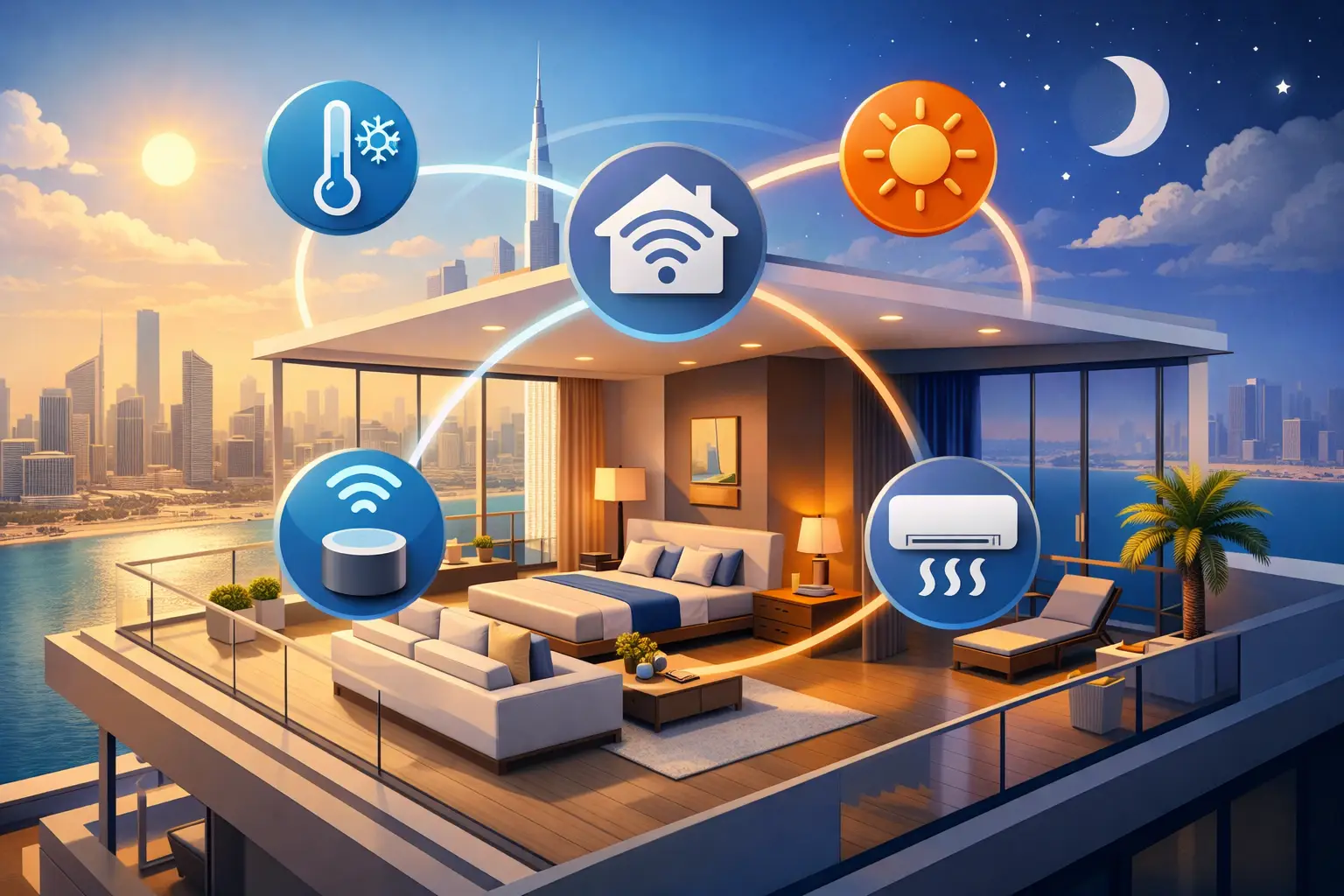
A penthouse can have floor-to-ceiling glass, dramatic views, double-height living areas, and several private zones – all of which make temperature control more demanding than it is in a typical apartment. Learning how to automate penthouse climate is less about adding a thermostat to the wall and more about coordinating air conditioning, motorized shades, occupancy, humidity, and user preferences as one intelligent system.
The goal is simple: every room should feel right when it is being used, while the property avoids cooling empty spaces or fighting the Dubai sun all day. A properly designed climate system delivers that comfort quietly, without requiring constant adjustments from your phone.
Why Penthouse Climate Needs a Different Approach
Penthouses are exposed to conditions that standard HVAC setups often do not address well. Large glazed facades can create intense solar gain in the afternoon. Bedrooms may need lower temperatures at night while entertainment spaces are active much later. Terraces, kitchens, and open-plan layouts introduce changing heat loads throughout the day.
A single thermostat cannot accurately represent these different environments. If it sits in a shaded hallway, it may signal the AC to stop while the living room near the windows remains warm. If it sits too close to a supply vent, it may cause the system to overcool other rooms.
Automation solves this by dividing the residence into meaningful climate zones and giving each zone the information it needs to respond correctly. The result is more consistent comfort, better energy management, and a more refined living experience.
How to Automate Penthouse Climate by Zone
Climate zoning is the foundation of a well-planned penthouse installation. Instead of treating the entire property as one temperature area, the system manages spaces according to how they are used, how much sun they receive, and when occupants are present.
A typical design might separate the formal living and dining space, family area, primary suite, guest bedrooms, kitchen, study, staff areas, and media room. A residence with a large terrace or multiple levels may need additional zones. The exact layout depends on the existing AC system, ceiling access, ductwork, fan coil units, and the control hardware selected.
Each zone receives a compatible smart thermostat or discreet temperature sensor. These devices report room conditions to the central automation platform, which can control fan coil units, thermostats, dampers, or compatible VRF and chilled-water systems. The right approach depends on the building’s mechanical design. In many Dubai apartments, careful integration with existing fan coil controls is more practical than extensive HVAC alterations.
Zoning should be purposeful, not excessive. Creating a separate zone for every small room can raise cost and complexity without improving comfort. A professional site assessment identifies where individual control will genuinely make a difference.
Use sensors, not assumptions
Temperature is only one part of indoor comfort. Humidity, occupancy, sunlight, door status, and air quality can also affect how a room feels. A sensor in a sun-facing lounge can detect when the space starts warming before residents notice it. The system can then lower the shades, adjust cooling, or do both in a coordinated response.
Occupancy sensors are particularly useful in secondary bedrooms, studies, dressing rooms, and staff areas. When a space has been empty for a defined period, the AC can move to an energy-saving setpoint rather than continue cooling at full comfort levels. When someone enters, the room can return to the preferred setting.
This is more reliable than manual routines because it responds to the way the penthouse is actually being used.
Coordinate Shades and AC for Better Results
Motorized curtains and blinds are among the most valuable climate-control tools in a glass-fronted penthouse. They reduce heat entering the property before the air conditioning has to remove it. This can improve comfort near windows and reduce unnecessary load on the HVAC system.
Automation can schedule shades to close during periods of direct sunlight, then open later to restore views and natural light. More advanced programming can account for façade direction, time of day, room temperature, and whether the property is occupied.
For example, living-room shades may lower partially in the afternoon to protect furnishings and reduce glare, while preserving the skyline view. In the primary suite, blackout curtains can close at bedtime and open gradually in the morning. The AC can then adjust in tandem, avoiding the familiar cycle of sun-heated rooms followed by aggressive cooling.
The trade-off is that shade automation needs thoughtful programming. A setting that prioritizes energy savings too heavily can make a home feel dark or closed off. Premium climate design balances thermal performance with privacy, daylight, and the architectural experience of the penthouse.
Build Climate Scenes Around Daily Life
The most useful automation is not a screen full of controls. It is a set of simple scenes that manage multiple systems at once.
A “Home” scene can return occupied areas to preferred temperatures, lift selected shades, and prepare the living spaces before residents arrive. A “Good Night” scene can cool bedrooms, reduce airflow in unused areas, close curtains, and lower lighting. An “Away” scene can place the entire home in an efficient standby mode while maintaining safe temperature and humidity limits.
For entertaining, a dedicated scene can account for the added heat from guests, cooking, lighting, and audiovisual equipment. The main living area may begin cooling slightly before an event, while guest areas remain comfortable without wasting energy in private rooms.
Voice control and a centralized app make these scenes easy to use, but they should not be the only way to operate the system. Well-designed automation continues to run in the background, with clear wall controls available for quick local changes. Residents should always be able to increase or reduce the temperature without searching through an app.
Plan Remote Access and Property Protection
Remote climate control is valuable for owners who travel frequently or manage a second residence. From a secure app, they can check temperatures, change modes, prepare the penthouse before arrival, or confirm that the property is operating as expected.
Remote access also supports property protection. In Dubai’s hot climate, an AC issue can become serious quickly in a closed residence. Alerts for unusually high temperature, high humidity, equipment faults, or water leaks allow the owner or property manager to act sooner. Depending on the system design, a leak sensor can also trigger an alert and close a connected water valve.
Security matters here. Climate controls should be installed on a properly configured network with secure user access rather than as a collection of unprotected consumer devices. Centralized control does not mean every system needs unrestricted internet access.
Choose Wired, Wireless, or a Hybrid System
The right automation architecture depends on the stage of the property. For a penthouse under construction or major renovation, a wired control system provides a clean long-term foundation. It is especially suitable where multiple systems, touch panels, sensors, shades, AV, lighting, access control, and HVAC are being integrated together.
For a completed residence, wireless devices and compatible control modules can often add intelligent climate control with minimal disruption. This is ideal when ceilings and finishes should remain untouched. A hybrid design is common: wired infrastructure where practical, with wireless controls in areas where new cabling is not justified.
Wireless does not automatically mean inferior, and wired does not automatically mean necessary. The decision should be based on coverage, reliability requirements, future expansion, construction constraints, and the level of integration expected.
Start With a Professional Climate Assessment
The best time to plan automation is before interior finishes are complete, but existing penthouses can also be upgraded effectively. The process should begin with a walkthrough of the property and its existing HVAC equipment. This reveals how many controllable zones are available, where sensors should sit, which areas experience heat gain, and whether motorized shades or additional controls are needed.
At Esmartech, the project process is designed to keep these decisions clear: consultation, system design and quotation, clean installation and testing, then user guidance at handover. The final system should be tailored to the space and the people using it, rather than built around a preset package.
Ask for a design that explains what happens when a room is vacant, when sunlight increases, when the property switches to away mode, and when internet service is unavailable. Climate automation should continue to provide local, dependable control even if remote features are temporarily unavailable.
A penthouse climate system earns its value on the hottest afternoon, the quietest night, and the day you arrive home after travel. Begin with the rooms that affect comfort most, then build a control strategy that makes every square foot feel considered.



Leave a comment