
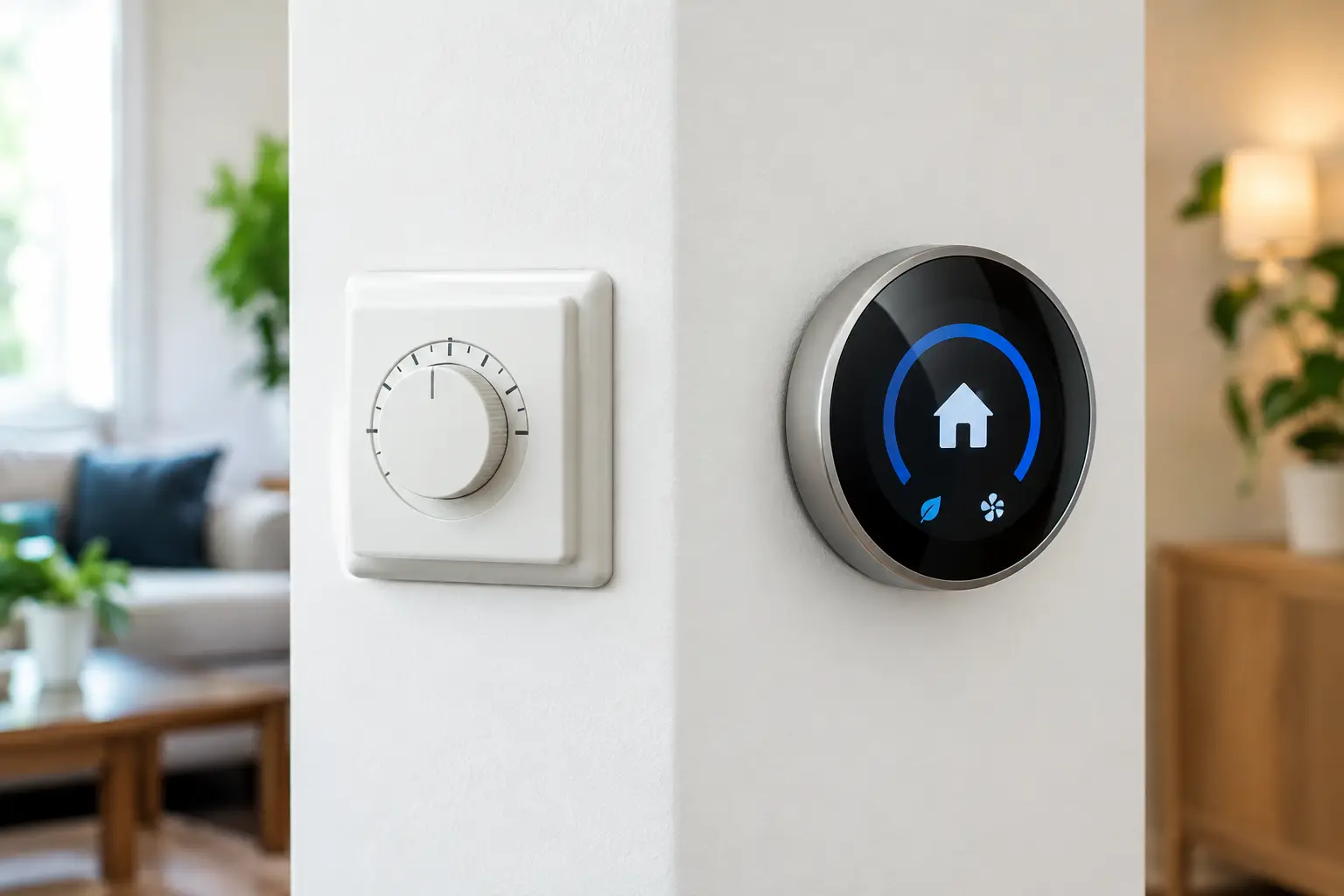
A thermostat can look like a small wall control, yet it has a major effect on comfort, cooling costs, and the way a property feels day to day. When comparing a wired thermostat versus smart thermostat, the best choice is rarely about choosing a more modern screen. It is about matching the control method to your HVAC system, daily routines, property type, and wider automation plans.
For a Dubai villa, a managed apartment, or a hospitality space, climate control needs to be reliable first. Intelligent control should then make that reliability easier to manage – whether that means setting one comfortable temperature, reducing unnecessary cooling, or coordinating AC with occupancy, curtains, and scenes.
Wired Thermostat Versus Smart Thermostat: The Key Difference
The terms can be confusing because they describe two different things. A wired thermostat refers to how the thermostat connects to the HVAC equipment: through physical control wiring. A smart thermostat describes what the thermostat can do: connect to an app, follow schedules, respond to sensors, and potentially integrate with a larger automation system.
That means a thermostat can be both wired and smart. In fact, a professionally integrated smart thermostat is often hardwired to provide a stable connection to the AC control system while adding intelligent features above it. The real decision is not always “wired or smart.” It may be whether to retain a basic wired controller, replace it with a standalone smart unit, or install a wired smart control system tailored to the property.
A conventional wired thermostat usually offers straightforward local operation. You select a temperature, choose cooling or heating where applicable, and adjust fan settings. This simplicity can be useful in a single room or a property where occupants prefer familiar controls and do not need remote access.
A smart thermostat adds layers of control. Depending on the system, users can adjust temperatures from a phone or centralized touchscreen, create schedules, receive system alerts, and use occupancy or temperature sensors to make more informed decisions. For multi-zone villas and commercial properties, the ability to see and manage multiple areas from one intelligent system can be far more valuable than the thermostat itself.
When a Basic Wired Thermostat Makes Sense
A standard wired thermostat remains a practical option in several situations. If the space has one simple HVAC zone, predictable operating hours, and no requirement for remote management, a conventional controller can deliver dependable comfort without unnecessary complexity.
It can also suit a renovation with limited scope. Replacing a damaged thermostat with a compatible wired model may be the sensible decision when the existing HVAC controls are working well and there is no intention to add automation later. In rental properties, some owners also prefer a familiar manual interface that requires minimal user guidance.
The trade-off is visibility and flexibility. A basic controller cannot tell an owner whether the AC has been left running in an empty property, allow adjustment before arriving home, or coordinate cooling with occupancy. It also creates separate control points in larger properties, which can become inconvenient when there are many rooms, floors, or guest areas to manage.
For commercial and hospitality projects, that limitation can become operationally expensive. A meeting room, suite, retail zone, or restaurant section may continue cooling long after it is vacant if there is no scheduling or occupancy-based logic in place.
What a Smart Thermostat Adds to the Property
A smart thermostat is most useful when it improves the way people operate a space. Remote access is often the first advantage homeowners notice. You can cool a villa before arriving, check a vacant apartment while traveling, or adjust a bedroom without walking to a wall panel.
Scheduling is equally valuable. Rather than relying on occupants to remember every setting, the system can follow the property’s normal rhythm: comfortable temperatures in the morning and evening, more efficient settings during working hours, and reduced cooling in unused zones. In the UAE, where cooling is a substantial part of household and building energy use, small improvements in operating habits can add up.
The strongest results come when thermostat control is part of a broader system rather than an isolated app. For example, a “Leaving Home” scene can raise AC setpoints, switch off selected lights, close curtains, and arm security features. A “Welcome” scene can restore preferred settings before the owner enters. In hospitality, room climate can be set back after checkout and prepared again before guest arrival.
Smart control also supports better oversight. Property managers can identify spaces that are repeatedly overcooled, verify whether a zone is responding as expected, and maintain consistent settings across multiple areas. This is useful for villas with staff accommodations, offices with meeting rooms, and restaurants that operate across long hours.
Compatibility Is More Important Than the Thermostat Design
Before selecting any thermostat, the HVAC system must be assessed. Not every smart thermostat works with every air-conditioning setup, and an attractive consumer device may not be suitable for a villa or commercial project.
Properties may use split AC units, ducted fan coil units, VRF or VRV systems, central chilled-water fan coils, or building management controls. Each can have different wiring, voltage, communication protocols, fan-speed requirements, and control logic. Some systems need specialist interfaces rather than a direct thermostat replacement.
This is particularly relevant in apartments and towers. Building rules, centralized cooling arrangements, and landlord or developer-installed controls may affect what can be changed. A professional site consultation prevents a common and frustrating outcome: purchasing a smart thermostat that powers on but cannot properly control fan speed, cooling modes, or the existing HVAC equipment.
For new villas and major renovations, wired controls are often the preferred foundation. Structured wiring provides dependable communication, avoids repeated battery changes, and supports a clean, permanent installation. Wireless devices can still be useful in completed properties where running new cable would disrupt finished interiors. The right architecture depends on the building, not a single product preference.
Reliability, Privacy, and Control During Internet Outages
Smart does not have to mean dependent on the internet for basic operation. A well-designed climate control system should retain essential local control when the internet connection is unavailable. Wall keypads, touch panels, and programmed schedules can continue to operate within the property, while remote app access may resume once connectivity returns.
This distinction matters for premium residences and operational businesses. Climate control is not a novelty feature. It must remain accessible to family members, guests, staff, and facilities teams without requiring everyone to use the same phone app or remember account details.
Security also deserves attention. Connected devices should be installed on an appropriate network, configured with secure access, and selected from established technology partners. In a larger automation project, it is preferable to have one managed platform for climate, lighting, curtains, access, and monitoring rather than a collection of unrelated apps with unclear support responsibility.
Cost Should Be Measured Beyond the Device
A basic wired thermostat is generally less expensive to purchase and install. A smart thermostat has a higher upfront cost, particularly where compatibility modules, sensors, control panels, or professional programming are needed. However, the device price is only one part of the decision.
Consider the value of reduced cooling in empty rooms, fewer calls to adjust settings for guests or tenants, and the convenience of managing a property remotely. For an investor with several apartments, centralized oversight may justify the additional investment. For a family villa, comfort and simple daily routines may matter more than direct energy savings.
It is also worth considering future expansion. A standalone thermostat may be enough today, but a property planning to add motorized curtains, lighting scenes, security, audio, or voice control should choose technology that can grow without forcing a full replacement later.
Choosing the Right Approach for Your Space
Choose a conventional wired thermostat when the HVAC system is simple, operation is local, and the goal is reliable temperature adjustment at the lowest practical cost. Choose a smart thermostat when schedules, remote access, multi-zone control, energy management, or integration with other systems will make the property easier to operate.
For high-value homes, hotels, offices, and mixed-use spaces, a wired smart control approach is often the strongest long-term answer. It combines the stability of professional wiring with the convenience of app control, scenes, sensors, and centralized management.
Esmartech begins with the property rather than a one-size-fits-all device. A proper consultation reviews the existing AC system, the number of zones, occupants’ routines, interior finish requirements, and the level of automation the owner wants to achieve. The system can then be designed, installed, programmed, tested, and explained clearly at handover.
The most useful thermostat is the one that disappears into everyday life: comfortable rooms when they are needed, sensible energy use when they are not, and control that remains simple for everyone who uses the space.



Leave a comment