
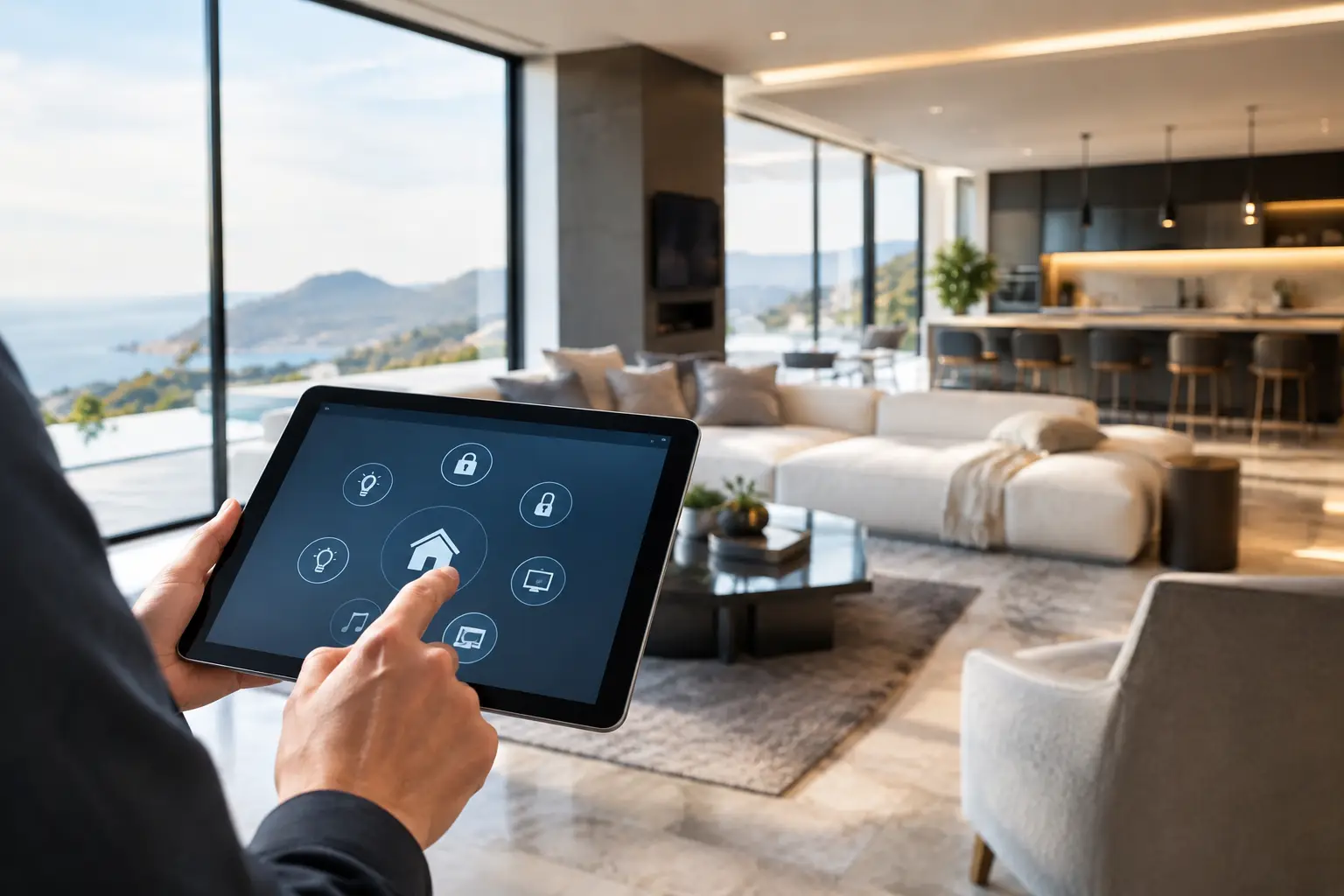
Smart home trends are transforming luxury living in Dubai, where homeowners increasingly seek greater comfort, security, convenience, and energy efficiency. From intelligent lighting and automated climate control to advanced security systems, motorized curtains, and centralized automation, modern smart home technologies are changing how premium villas and apartments operate. In this guide, Esmartech explores the innovations shaping the future of luxury homes.
For homeowners, developers, and hospitality operators, the value is not technology for its own sake. It is greater control, stronger security, reduced waste, and a property that feels more considered at every touch point. The best results come from planning the system as part of the property, not adding devices room by room after handover.
Top Smart Home Trends Transforming Luxury Properties in Dubai
The most meaningful trend is integration. A smart lock, thermostat, camera, curtain motor, and speaker can all be useful on their own. Yet their real value increases when they work together through a central interface, with automation that supports daily routines and operational needs.
One platform for the systems people use every day
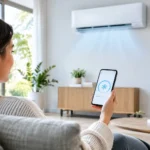
Property owners increasingly expect lighting, air conditioning, curtains, access control, CCTV, entertainment, and intercom functions to be managed from one app, wall keypad, or voice-enabled platform. This avoids the common frustration of having one application for lighting, another for cameras, and another for climate control.
Centralized control also makes a large villa, penthouse, hotel suite, or commercial space easier to manage. A homeowner can check whether doors are secured while traveling. A facilities manager can review common-area lighting and climate settings without walking through every zone. The goal is not to put every function on a phone. It is to make the right controls available in the right place, whether that is a discreet keypad, a touch panel, a mobile app, or an automated scene.
Energy management that does not compromise comfort
Energy-conscious operation is becoming a core part of premium automation design. In warm climates, cooling often represents a major portion of a property’s consumption. Smart thermostats, occupancy sensors, automated blinds, and scheduled climate settings can reduce unnecessary operation while maintaining a comfortable environment.
For example, a system can ease cooling in unoccupied rooms, close curtains during peak afternoon sun, or return a bedroom to the preferred temperature before its occupants arrive. In an office or restaurant, schedules can align lighting and air conditioning with opening hours, while staff retain simple manual control when conditions change.
This is not a case for setting rigid rules that make a home feel restrictive. The right energy strategy depends on the building envelope, occupancy pattern, equipment type, and the owner’s priorities. Automation should quietly remove waste while allowing people to enjoy the space as they choose.
Security designed as part of the living experience
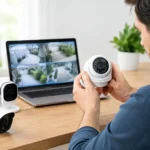
Security systems are moving beyond isolated alarms and standalone cameras. Current smart home trends favor connected layers of protection: video intercoms, smart locks, access control, CCTV, motion sensors, door and window contacts, and real-time notifications coordinated within one system.
A well-designed arrival scene might switch on exterior lighting, open an authorized gate, disarm selected zones, and notify the owner when a visitor is at the entrance. At night, a single command can secure doors, lower shades, switch off selected lights, and activate perimeter monitoring.
Convenience should never weaken security. Remote access needs appropriate user permissions, secure network design, reliable hardware, and clear control over who can enter which areas. This matters especially for villas with household staff, multi-unit properties, rental residences, hospitality venues, and offices with changing teams.
Personalized scenes instead of constant manual adjustments
The most successful automation feels personal, not complicated. Rather than asking occupants to control ten individual devices, a scene brings together the settings that suit a particular moment.
A “Good Morning” scene may raise bedroom curtains gradually, adjust the climate, and turn on soft lighting in key areas. “Movie Time” can lower the shades, set accent lights, and prepare the entertainment system. “Away” can turn off nonessential equipment, adjust air conditioning, and secure the property.
These scenes should be tailored rather than copied from a showroom demonstration. A family with young children, a frequent traveler, and a property owner who entertains regularly will use the same technology very differently. Custom programming is what turns a collection of products into a home that responds naturally.
What Smart Home Trends Mean for New Builds and Renovations
The decision between wired and wireless automation is one of the most practical considerations in any project. Both can deliver excellent results, but the best choice depends on the property, the scope of work, and future plans.
Wired systems offer long-term structure
For new construction and major renovations, a wired infrastructure can provide a strong foundation for lighting control, shading, climate integration, security, and audiovisual systems. It keeps key functions within a planned architecture and can be particularly valuable in large villas, hospitality projects, offices, and properties with many zones.
Wired systems require early coordination with the architect, interior designer, MEP contractor, and construction team. Planning cable routes, equipment locations, keypad positions, and network requirements before finishes are installed can prevent costly compromises later. It also allows technology to remain visually discreet, which is essential in high-end interiors.
Wireless upgrades can be highly effective
Wireless automation is often the practical choice for occupied homes, apartments, and targeted upgrades where opening walls is undesirable. Modern wireless solutions can bring intelligent lighting, climate control, smart locks, sensors, and selected security features to a property with minimal disruption.
That said, wireless should not mean unplanned. Signal strength, building materials, device placement, network quality, and battery maintenance all affect performance. A professional site assessment identifies where wireless is appropriate and where a wired connection or dedicated network equipment may be the better choice.
AI should be useful, not intrusive
Artificial intelligence is receiving considerable attention in home technology, but the useful applications are often simple. Systems can learn preferred temperature ranges, identify unusual energy use, refine lighting schedules, or help recognize patterns around occupancy.
The trade-off is privacy and predictability. Not every property owner wants a system that makes broad assumptions about daily life. A premium installation should give the user clear visibility and control over automations, notifications, permissions, and data-connected features. Technology earns trust when it is helpful, transparent, and easy to override.
The network is now part of the property infrastructure
Every connected property relies on a dependable network. Cameras, intercoms, streaming systems, smart appliances, access devices, and mobile controls all compete for capacity. Poor Wi-Fi can make a carefully selected automation system appear unreliable, even when the underlying devices are functioning correctly.
A proper design considers Wi-Fi coverage, wired network connections, equipment ventilation, backup power for critical functions, and network separation where appropriate. In larger properties, this planning is as fundamental as electrical and plumbing coordination. It supports responsive control today and makes future expansion far easier.
Planning a Smart Property That Will Still Feel Current
The fastest route to disappointment is buying devices before defining what the property needs to achieve. Start with the daily experience: how residents arrive, which rooms are occupied most, when privacy matters, how guests are received, and what needs to be monitored when the property is empty.
For commercial and hospitality projects, consider operational questions as well. Which staff members need access? Which areas require different schedules? How should guest comfort, energy use, safety, and brand presentation work together? A restaurant may prioritize lighting moods, music zones, and staff-controlled climate. A hotel may focus on guest-room comfort, access management, and centralized oversight. The systems may overlap, but their programming should not be identical.
A professional integrator can then translate those requirements into a clear design, quotation, installation plan, and handover process. At Esmartech, this approach includes consultation, system design, installation and testing, then user guidance so the property team or homeowner understands the controls from day one.
The most valuable smart property is not the one with the longest feature list. It is the one where security feels assured, comfort feels immediate, and every control has a clear purpose. Plan for that experience first, and the technology will have room to evolve with the property.

Leave a comment