
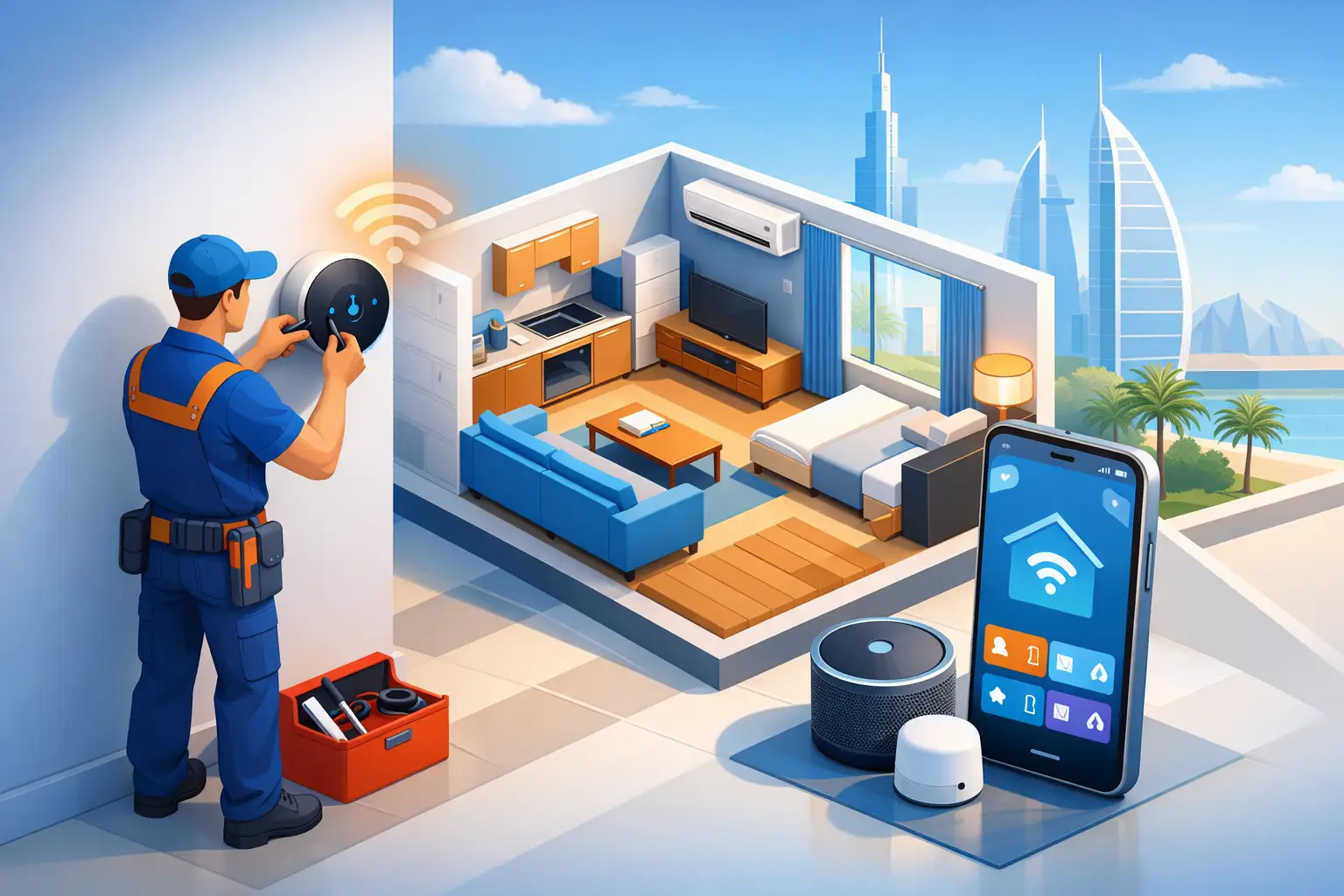
A smart thermostat can make a Dubai property noticeably more comfortable, but only when it is designed around the air-conditioning system already in place. Smart thermostat installation Dubai is not simply a matter of replacing a wall controller with a newer screen. In villas, apartments, penthouses, offices, and hotels, the thermostat must communicate correctly with the fan coil unit, split AC, VRF system, or chilled-water controls behind the wall.
That technical detail determines whether the system provides reliable climate control or creates inconsistent temperatures, unnecessary service calls, and frustrated occupants. A professionally planned installation gives you precise control of each space, practical energy management, and the option to integrate climate with lighting, curtains, occupancy sensors, and a central smart-home platform.
Why Dubai Properties Need a Different Approach
Cooling is not an occasional convenience in Dubai. It is one of the property’s most important operating systems. Long periods of high outdoor temperatures, strong solar gain through glass, varying occupancy, and humidity all affect how a room feels. A thermostat that works well in a mild climate may not be the right choice for a villa with multiple fan coil zones or an apartment served by a centralized chilled-water system.
The first question is not which thermostat has the most features. It is what the existing HVAC equipment needs in order to operate safely and accurately. Some systems use conventional low-voltage wiring; others use proprietary controllers, dry contacts, fan-speed connections, or building management interfaces. The wrong device can limit fan control, cause equipment to cycle too often, or fail to control the valve and cooling demand as intended.
For this reason, smart thermostat installation should begin with a site assessment. A qualified integrator identifies the AC type, existing wiring, control signals, power availability, number of zones, and the owner’s preferred control method before recommending a solution.
What a Smart Thermostat Should Control
A quality installation does more than allow temperature adjustments from a phone. It should give the property owner useful control without making daily operation complicated.
In a typical residence, each thermostat can manage temperature, cooling mode, fan speed, and scheduling for its assigned zone. In larger villas, this allows bedrooms, living areas, guest rooms, and staff areas to operate according to how they are actually used. There is little reason to cool a rarely occupied wing at the same level as the family living area.
In commercial and hospitality settings, the opportunity is broader. Climate schedules can follow business hours, meeting-room use, guest occupancy, or approved facility-management policies. A restaurant may require a different cooling strategy for dining areas, kitchens, and private rooms. A hotel operator may need guest-friendly in-room control while retaining appropriate central oversight.
The most effective setups can also work with occupancy sensors, door contacts, curtains, and scene controls. For example, closing motorized curtains during peak sunlight can reduce heat gain in a glass-fronted room. An away scene can adjust selected zones to an energy-conscious setpoint while switching off unnecessary lighting and entertainment equipment.
Compatibility Comes Before Design
The polished wall interface is only one part of the system. Compatibility is where the real value of professional planning becomes clear.
Fan Coil Units and Chilled-Water Systems
Many Dubai apartments, towers, and larger properties use fan coil units connected to chilled water. These may require control of a cooling valve, multiple fan speeds, and an existing thermostat connection. A compatible smart controller must handle these functions correctly, not just send a basic on-off command.
It is also important to understand what is controlled by the apartment and what is managed by the building. In some communities, the central plant, cooling allocation, or temperature limits are governed at a wider level. The smart thermostat should improve local comfort while working within the property’s existing infrastructure.
Split, Ducted, and VRF Air Conditioning
Split AC and ducted systems can sometimes be controlled through wired interfaces, infrared gateways, or manufacturer-approved integrations. VRF systems often need more specialized coordination because indoor units, central controllers, and manufacturer protocols may all be involved.
An infrared solution can be practical in certain retrofit projects, particularly where opening walls is not desirable. However, it may not provide the same level of feedback or reliability as a properly wired control interface. The right choice depends on the equipment, the room layout, and how much control the owner expects.
Existing Wiring and Power
Older thermostats do not always have the wiring needed for every smart device. Adding a controller may require a new cable, a suitable power supply, or a control module installed near the fan coil unit. These are normal project considerations, but they should be identified before a product is selected and before finishes are disturbed.
Wireless automation can reduce the need for major wiring changes in completed properties. Wired solutions can be an excellent fit for new villas, renovations, hotels, and projects where long-term system expansion is planned. Neither approach is automatically better. The best architecture is tailored to the property, its construction stage, and its operational requirements.
Smart Thermostat Installation Dubai: A Clear Process
A successful project should feel organized from the first conversation through handover. The work may be technical, but the experience for the owner should remain straightforward.
1. Consultation and Site Assessment
The process starts by reviewing the property, HVAC equipment, number of controlled zones, current wall controls, and desired user experience. This is also the time to discuss whether the thermostat will operate independently or become part of one intelligent system for lighting, curtains, security, audio, and access control.
For an occupied apartment, the priority may be a clean retrofit with minimal disruption. For a new luxury villa, the conversation may focus on zone planning, centralized control, architectural finishes, and future scalability.
2. System Design and Clear Quotation
After the assessment, the proposed solution should specify what each thermostat will control, how it will connect to the AC system, and which app, touch panel, or voice controls will be available. A clear quotation avoids vague promises and confirms the scope of equipment, installation, programming, testing, and user guidance.
This stage also prevents a common mistake: buying consumer devices before confirming that they are compatible with the installed HVAC system. A lower initial product price can become expensive if adapters, extra wiring, replacement controllers, or repeated troubleshooting are required later.
3. Installation and Programming
During installation, the technician safely replaces or supplements existing controls, completes the required wiring or interfaces, and labels equipment where appropriate. The thermostat is then programmed for the correct cooling logic, fan operation, temperature limits, and schedules.
Programming should match how the property is lived in. A family villa may use morning, daytime, evening, sleep, and travel settings. An office may use weekday schedules with manual overrides for late meetings. In hospitality, guest controls should be simple while operational settings remain protected.
4. Testing and Handover
Testing is essential because a screen that powers on does not prove the AC is functioning correctly. Each zone should be checked for cooling response, fan-speed control, app communication, scheduling, and integration with any connected scenes or sensors.
At handover, users should know how to adjust the temperature, select a mode, create basic schedules, and use remote access without relying on trial and error. They should also understand when to contact support, particularly if a building-wide chilled-water issue or AC maintenance concern is affecting performance.
Energy Savings Are Real, but Not Automatic
Smart climate control can reduce unnecessary cooling, especially in large villas, investment properties, offices, and spaces with inconsistent occupancy. Scheduling, remote adjustments, occupancy-based logic, and zone control all help prevent AC from running at full comfort settings when nobody needs it.
Still, savings depend on the property. Poor insulation, open doors, aging fan coils, dirty filters, undersized equipment, and frequent changes to very low setpoints can reduce the benefit. The thermostat manages operation; it cannot correct underlying HVAC faults.
A sensible strategy is to use moderate setpoints, schedule unoccupied periods appropriately, and cool only the zones in use. In a high-end home, this approach supports comfort rather than sacrificing it. The goal is not to make rooms warm. It is to stop wasting cooling where it adds no value.
When Integration Adds More Value
A single smart thermostat is useful. A coordinated system becomes more valuable as the property becomes larger or more complex.
When climate is integrated with curtains, lighting, sensors, and security, the home can respond to real conditions instead of fixed routines. An arrival scene can prepare selected areas before residents enter. A bedtime scene can lower bedroom temperatures, close curtains, and switch off lights. An away mode can adjust climate settings across the property while confirming that doors are secured.
For developers and property investors, professionally installed control systems can also strengthen the appeal of a premium unit. Buyers and tenants increasingly expect convenient app-based control, but they also expect it to work reliably and look appropriate within a finished interior.
The best smart thermostat is not necessarily the most visible or feature-heavy model. It is the one that fits the AC system, supports the way the property is used, and remains easy to operate long after installation. With a tailored assessment, careful programming, and proper testing, Esmartech can turn everyday cooling control into a more comfortable, efficient, and refined part of the property experience.



Leave a comment