
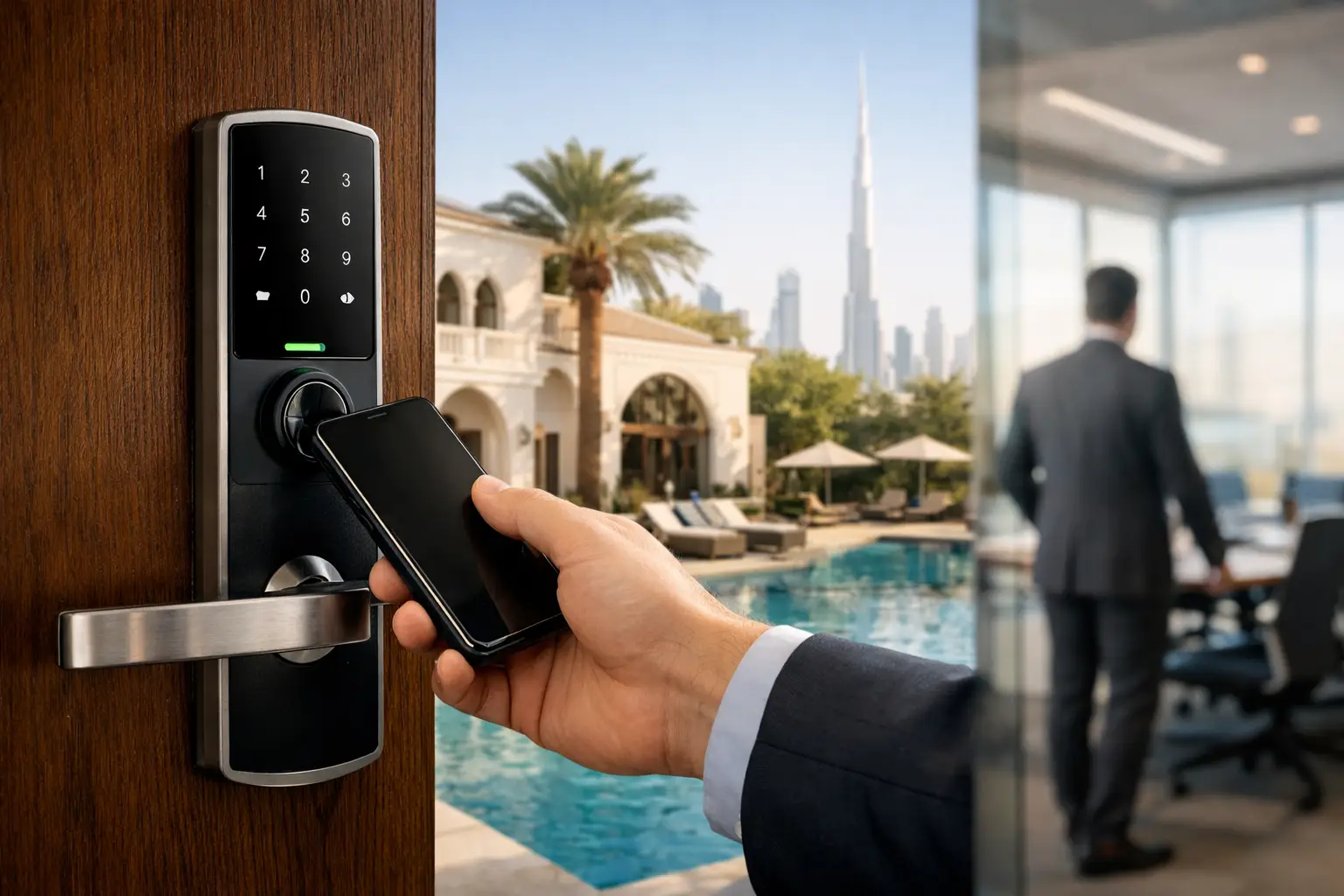
A villa gate left open for a contractor, a lost staff key, or a guest arriving before the property manager should not require a rushed trip across Dubai. Smart locks replace many of those friction points with controlled, trackable access from one intelligent system. For homeowners, developers, and hospitality operators, the real value is not simply opening a door with a phone. It is knowing who can enter, when they can enter, and what happens when plans change.
The right system should feel effortless for residents and staff while giving property owners clear control. That requires more than selecting an attractive lock from a catalog. Door construction, access habits, network coverage, emergency procedures, and integration with the wider automation system all affect the result.
What smart locks change in a property
A conventional key gives permanent access until it is collected or the cylinder is changed. Smart locks allow access to be issued, adjusted, and removed without creating a new physical key for every visitor. Depending on the selected system, users may enter with a PIN code, fingerprint, card, mobile app, Bluetooth credential, or a physical key kept as a backup.
This is particularly useful in properties with changing access needs. A homeowner can provide a time-limited code for a housekeeper. A villa manager can receive an alert when a maintenance team arrives. An office administrator can remove an employee’s credential immediately when employment ends. In a holiday home or hotel setting, access can be scheduled around guest arrival and departure times.
The record of activity is equally valuable. Rather than asking whether a door was locked or who last had a key, authorized users can review access events in the app. That visibility supports security, service coordination, and accountability, especially in larger villas, multi-unit residential projects, and commercial premises.
Choosing smart locks for the door, not just the feature list
The most capable lock is not necessarily the best choice. A premium entrance door, a glass office partition, a gate, and an internal staff room each have different hardware, security, and usage requirements. The first question is whether the device is compatible with the existing door or whether the door should be prepared for a different lock body during fit-out.
Door type and local conditions
Door thickness, handle design, mortise dimensions, swing direction, and locking points must be measured before selection. Many high-end villas use heavy timber, metal, or reinforced doors with multipoint locking. In these cases, the smart lock may need to work alongside the existing mechanical hardware rather than replace it entirely.
For exterior locations, heat, dust, humidity, and direct sun exposure matter. A lock installed on a shaded apartment entrance has a different operating environment from one mounted at a villa gate or outdoor service entrance. Outdoor-rated hardware, protected wiring, and correctly positioned readers help protect performance over time.
Access methods that suit real users
Fingerprint access is convenient for residents who do not want to carry keys or remember codes. PIN codes work well for cleaners, drivers, visitors, and short-term access. Cards and fobs are often practical in offices, hotels, and buildings where staff turnover or many daily users must be managed. Mobile credentials offer flexibility, but they should not be the only way to enter a property.
A well-designed project typically combines methods. For example, a family may use fingerprints and mobile access, while domestic staff use scheduled PIN codes and the property manager retains a protected mechanical override. The aim is simple access for legitimate users without relying on a single device, app, or person.
Security features that deserve attention
Look beyond the headline features. A suitable smart lock should support encrypted communication, tamper alerts, automatic locking options, low-battery warnings, and a dependable manual entry method. It should also have clear permissions management, so the owner can see exactly which users have access.
Automatic locking can be valuable, but its settings need care. A front door that locks after a short delay may improve security for a busy household. On the other hand, a staff entrance or stockroom may need a different timing rule to avoid disrupting operations. Access control should reflect the way the property actually functions.
Integration turns a lock into part of the property system
A standalone lock can solve a straightforward access problem. Integration becomes more valuable when the door is one part of a larger experience. At a villa, disarming an approved security mode at entry can trigger entrance lighting, adjust climate settings, and notify the homeowner that a family member has arrived. At an office, a credential can control access to designated areas while maintaining a useful activity record.
For hospitality projects, the opportunity is operational. Guest access, common-area permissions, housekeeping schedules, and back-of-house controls can be organized around a unified approach rather than separate, disconnected devices. A reception or management team should not need multiple apps to understand who has access to which areas.
Integration must be planned carefully. Not every event should activate multiple systems, and not every user needs the same permissions. A visitor entering a villa should not receive the same control as the homeowner. A restaurant supplier may require access to a service entrance during a specific delivery window, not access to the full premises. Clear rules keep the system useful instead of complicated.
Wireless or wired installation: the right answer depends on the project
Wireless smart locks are often a strong choice for completed homes, apartments, and offices because they reduce disruption to finishes. They can be installed with minimal modification when the existing door is compatible. Battery-powered models also continue basic operation during a power interruption, although batteries must be monitored and replaced according to the manufacturer’s guidance.
Wired access control is often better suited to new construction, major renovations, hotel projects, and high-traffic commercial areas. It can support centralized power, broader access-control infrastructure, door sensors, exit devices, and more detailed management requirements. The upfront planning is greater, but the result is usually more suitable for properties with many doors and users.
Network design is another practical consideration. Wi-Fi-connected devices may be convenient, but a weak signal near an entrance can cause avoidable frustration. Bluetooth, mesh protocols, gateways, and hardwired controllers each have a role depending on the property layout and desired level of integration. A site assessment identifies coverage gaps before hardware is installed.
Installation details determine long-term reliability
A lock may appear simple from the outside, yet precise alignment is essential. The latch, strike plate, door closer, frame, and weather seals must work together without resistance. If a heavy door drops slightly over time or the frame is misaligned, forcing the lock to compensate can shorten its life and affect security.
Professional installation also includes testing the day-to-day scenarios that brochures rarely address. What happens if the battery is low? Can a resident enter when their phone is unavailable? Does the door relock correctly after a gate closes? Who receives a notification when repeated invalid codes are entered? Is there a safe, documented process for emergency access?
For commercial and hospitality properties, installation should also align with fire and life-safety requirements, egress rules, and building-management policies. Access control must never create an unsafe exit route. This is one reason smart lock selection should be treated as a system design decision, not an online purchase.
A practical access plan before installation
Before choosing hardware, map the people and doors involved. Residents, household staff, guests, maintenance teams, security personnel, tenants, deliveries, and managers rarely need identical access. Defining these groups early makes programming simpler and reduces future exceptions.
Consider four questions: Which doors need control? Which users need access, and at what times? What should be recorded or reported? What must continue working during an internet or power issue? The answers guide whether a single smart lock is enough or whether the property needs a broader access-control system.
Esmartech approaches this through consultation, clear system design and quotation, clean installation and testing, then user guidance at handover. That process is especially useful where locks need to work with CCTV, intercoms, gates, lighting, climate control, or a centralized property app.
A smart lock should make entry more controlled without making daily life harder. Start with the doors people rely on most, build permissions around real routines, and choose hardware that can grow with the property rather than becoming the next device everyone has to work around.

Leave a comment