
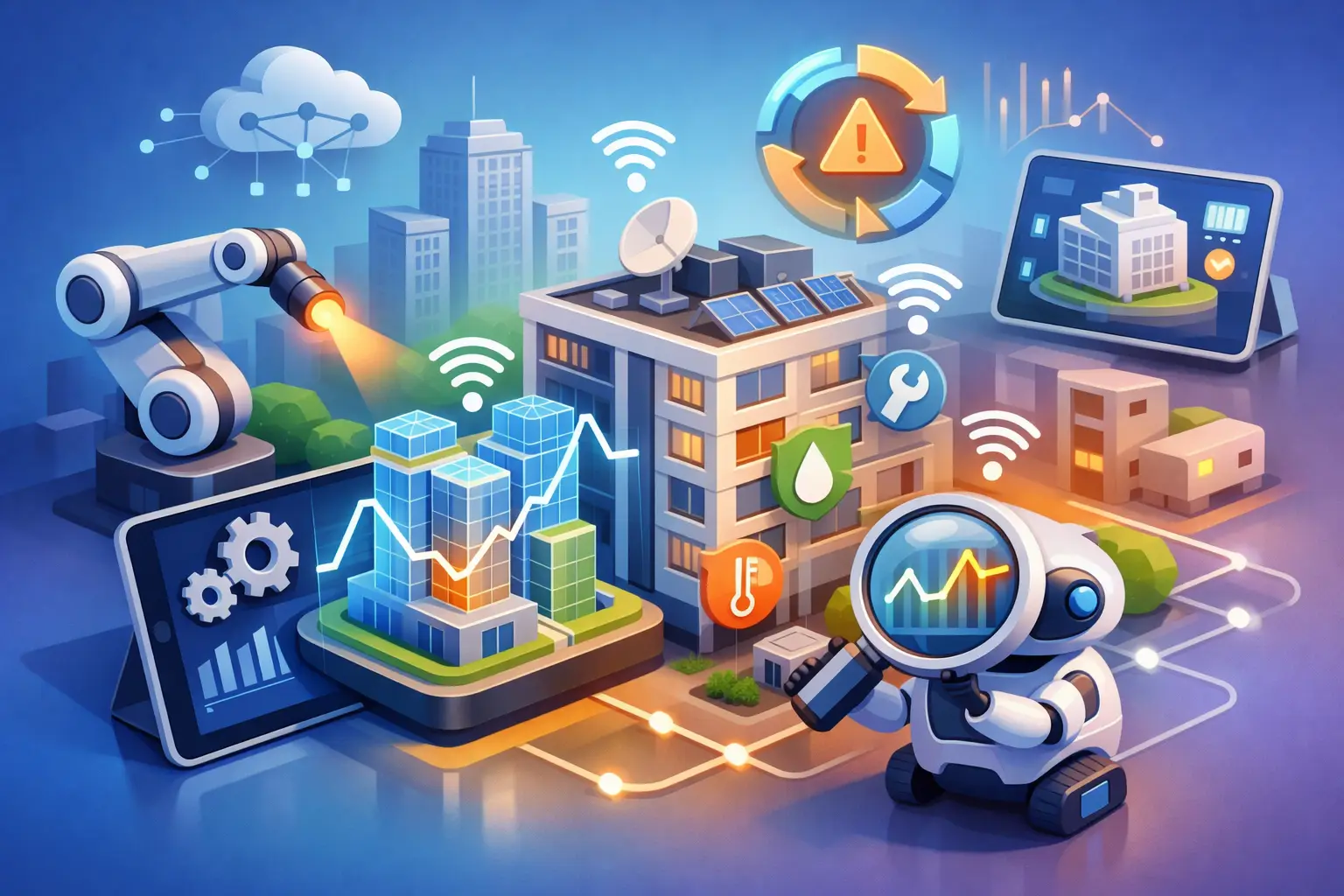
A villa’s air conditioning does not usually fail without warning. A pump may run longer than normal, a fan coil may draw more power, or a temperature sensor may begin reporting inconsistent readings days before comfort is affected. The most valuable predictive maintenance trends turn those early signals into a service decision before a family, guest, tenant, or business feels the disruption.
For high-value homes, hotels, offices, and retail spaces, this is not simply a facilities upgrade. It is a shift from reacting to faults toward operating the property with greater visibility, comfort, and control. The goal is not to replace every planned service visit with software. It is to combine professional maintenance with accurate system data, so attention goes where it is needed most.
Predictive Maintenance Trends Changing Smart Properties
Predictive maintenance uses data from equipment and sensors to estimate when a component may require attention. Unlike reactive maintenance, which begins after a failure, it looks for performance changes before the failure occurs. Unlike a fixed preventive schedule, it does not assume every asset needs the same level of service at the same interval.
This distinction matters in Dubai, where HVAC systems work hard for long periods, and where a minor issue can quickly affect indoor comfort, energy consumption, or equipment life. It also matters in hospitality and commercial environments, where an unavailable room, uncomfortable guest area, or access-control fault can affect operations immediately.
HVAC intelligence is becoming the priority
Air conditioning is the clearest starting point for predictive maintenance in UAE properties. Smart thermostats, connected controllers, occupancy sensing, temperature and humidity sensors, and energy monitoring can reveal how a cooling system is actually behaving across the day.
A system may flag repeated temperature recovery delays, unusual runtime, rising power use, or a zone that remains warmer than its set point. None of these signals alone proves that a compressor, filter, valve, or sensor is failing. Together, they give a qualified technician a much stronger reason to inspect a specific part of the system.
For a villa, this can protect comfort in bedrooms, living spaces, and outdoor-adjacent areas that experience different heat loads. For a hotel or office, it can help facilities teams prioritize critical spaces rather than discovering complaints one room at a time. The practical advantage is fewer emergency callouts and a more informed maintenance visit.
One intelligent system creates better context
Equipment data is far more useful when it is not isolated. A temperature alert means something different if the room is occupied, the curtains have been open through the afternoon, the door has been repeatedly accessed, or the air conditioning has been intentionally set to an energy-saving mode.
That is why centralized automation is shaping predictive maintenance trends. When lighting, climate, curtains, occupancy sensors, access control, and energy data operate through one intelligent system, property managers can understand the conditions around an alert. The system can distinguish between an actual performance concern and normal behavior caused by how a space is being used.
For example, a meeting room that overheats every afternoon may not need a larger AC unit. The cause could be direct sun exposure, curtain schedules that do not match occupancy, or lighting and audiovisual equipment adding heat during presentations. An integrated design helps identify the operating pattern before money is spent on the wrong repair.
Energy data is becoming an early warning signal
Energy management is no longer only about reducing utility bills. Changes in energy use can be one of the earliest indications that equipment is under strain. A motor running longer, an inefficient cooling cycle, or lighting that remains active in unoccupied areas can create a pattern worth investigating.
The key is setting a sensible baseline. A luxury villa occupied by a large family will not behave like the same villa when it is vacant for the summer. A hotel’s energy profile will change with occupancy, events, and seasonal demand. Good predictive maintenance compares current behavior with the property’s own normal patterns, not with a generic benchmark.
This approach also supports more considered upgrades. If data shows that a particular zone consistently consumes more energy while delivering less comfort, the answer may be improved controls, zoning, sensor placement, shading, or equipment servicing. It depends on the building design and the condition of the existing system.
AI Can Prioritize Data, Not Replace Expertise
Artificial intelligence is frequently presented as the answer to every building problem. In practice, its most useful role is narrower and more practical: it can review large volumes of sensor data, identify anomalies, and prioritize issues that deserve human attention.
For a property with multiple AC zones, pumps, smart locks, CCTV cameras, and automated lighting scenes, a dashboard can generate many alerts. Without intelligent filtering, that volume becomes noise. AI-supported analytics can recognize recurring patterns, such as a device that disconnects at the same time each day or a climate zone whose performance steadily declines.
But a prediction is not a diagnosis. Sensor readings can be affected by installation location, battery condition, network coverage, calibration, or changes in how the space is used. A professional team still needs to verify the issue on site, assess the equipment, and decide whether the right response is adjustment, service, repair, or replacement.
The strongest systems therefore combine automation intelligence with clear accountability. Property owners should know who receives an alert, who checks it, how urgent issues are escalated, and what happens if the internet connection is unavailable. Technology should reduce uncertainty, not create another platform that no one actively manages.
Security and Access Systems Need Health Monitoring Too
Predictive maintenance is expanding beyond mechanical equipment. Smart locks, intercoms, CCTV, access-control panels, network switches, and backup power devices all have operating signals that can reveal developing issues.
A camera that is intermittently offline, a door lock with declining battery health, or an access reader with repeated failed scans may not feel urgent until it affects security or guest access. Health monitoring can surface those exceptions early and allow work to be planned around the property’s schedule.
For hotels, residential towers, and commercial facilities, this is especially valuable because security devices are often distributed across many entrances and shared areas. Centralized visibility helps operators confirm that critical systems are online and functioning as intended without relying solely on manual checks.
There is a trade-off. More connected devices create more data and more cybersecurity responsibility. Any predictive maintenance strategy should include secure network design, controlled user permissions, strong passwords, firmware management, and a clear understanding of where system data is stored. Premium properties need convenience, but they also need disciplined protection.
Retrofitting Requires a Different Strategy Than New Construction
Predictive features are easiest to plan during a new build or major renovation, when wiring, equipment locations, control panels, and sensor placement can be designed together. A wired system may offer dependable communication and broad integration possibilities for large villas, hotels, and offices.
Existing properties can still benefit significantly. Wireless sensors and controllers can add visibility without opening every wall or disrupting finished interiors. The limitation is that a retrofit should begin with the assets that matter most, rather than attempting to monitor everything at once. HVAC performance, water leaks, critical doors, pumps, and high-use common areas are often sensible first priorities.
The right architecture depends on the building, the available infrastructure, the desired level of control, and the owner’s budget. A well-designed phased approach can protect investment while leaving room for future expansion.
How to Make Predictive Maintenance Useful
Successful implementation begins with a site assessment, not a shopping list of sensors. The first step is identifying which failures cause the greatest cost, inconvenience, or risk. In a family villa, that may be cooling, water leaks, gates, and security. In a hospitality property, it may include guest-room climate, access systems, laundry equipment, and common-area lighting.
Next, establish what normal operation looks like. This requires accurate installation, tested controls, and a period of observation. Alerts should be configured around meaningful changes, with different priorities for a minor battery warning and a critical equipment fault.
Finally, connect the system to a maintenance process. A notification only creates value when someone can act on it. Esmartech designs tailored automation systems with the consultation, installation, testing, and handover needed to make that process clear for the people who will use and maintain the property.
The best predictive maintenance plan is often quiet. It does not overwhelm owners with notifications or turn a beautifully designed property into a control room. It gives the right person the right warning early enough to protect comfort, security, and the life of the systems behind the walls.





Leave a comment