
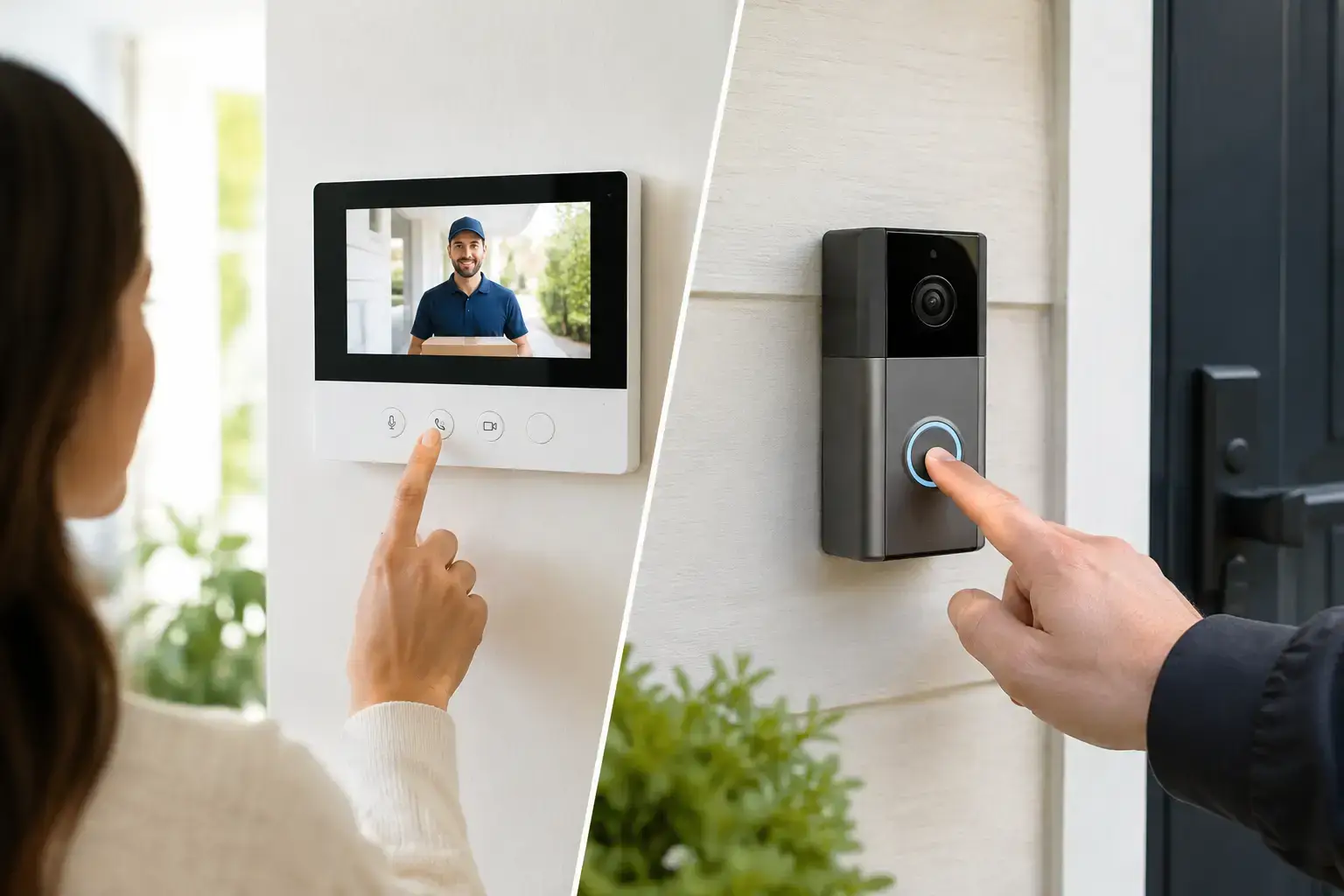
A delivery arrives while you are away, a guest reaches the gate after dark, or a service team needs access to a villa compound. These are the moments when the choice between a video intercom versus doorbell becomes more than a design preference. It determines how confidently you can see, speak with, verify, and admit visitors.
Both solutions add visibility at the entrance. However, they are designed for different levels of access control, property complexity, and daily use. A video doorbell is often an effective upgrade for a single entrance. A video intercom is built to manage communication and access across gates, doors, apartments, staff areas, and shared facilities.
For premium homes, developments, offices, and hospitality spaces, the right answer depends on what sits beyond the front door.
Video Intercom Versus Doorbell: The Core Difference
A video doorbell is usually a compact device installed beside a front door. When someone presses it, the owner receives a call or alert through a mobile app and can view live video, speak to the visitor, and, in some setups, activate a compatible smart lock. It is primarily a visitor-notification device with video verification.
A video intercom is a dedicated entry communication and access system. It normally includes an outdoor door station with a camera, microphone, speaker, call button, and often card, PIN, QR, or biometric access options. Inside, residents or staff can use fixed touchscreens, indoor stations, mobile devices, or a centralized control platform to answer calls and release doors or gates.
The practical distinction is simple: a doorbell helps you respond to a visitor at one entrance. An intercom manages who enters, where they are allowed to go, and how entry events are handled across the property.
When a Video Doorbell Is the Right Choice
A video doorbell can be a smart choice for an apartment, a small home, or a single-entry office where the main requirement is knowing who is outside. It is typically faster to deploy and can be especially useful where running new cables is difficult or unnecessary.
For residents who travel frequently, phone alerts are a major advantage. You can speak to a courier, confirm a visitor has arrived, or check an entrance recording from almost anywhere. Many models also provide motion alerts and cloud or local video storage, depending on the product and configuration.
A doorbell is most suitable when the property has one primary door, limited visitor traffic, and no need for multiple indoor stations or complex permissions. It can also work well as part of a smaller smart-home upgrade, particularly when paired with a smart lock, lighting scene, or CCTV camera.
There are trade-offs. Consumer-grade doorbells often rely heavily on Wi-Fi and app notifications. In larger villas with thick walls, landscaped grounds, basements, or gatehouses, network coverage must be planned carefully. Battery-powered models also require ongoing charging or battery replacement, which is not ideal for entrances that need consistent operation.
A video doorbell may also feel limited once a property has a pedestrian gate, vehicle gate, main entrance, staff access point, and separate service entrance. At that stage, adding individual devices can create multiple apps, inconsistent user experiences, and no clear access strategy.
When a Video Intercom Makes More Sense
A video intercom is designed for properties where entry is part of the wider security and lifestyle system. In a villa, it can link the outer gate, front door, driveway gate, indoor touch panels, smart locks, CCTV, and a mobile app. A homeowner can see a guest at the gate, speak with them, open the pedestrian entrance, and keep the main home secure.
For apartment buildings and gated communities, intercom systems offer a more structured approach. Visitors can call a specific unit from a directory, while residents answer through an indoor monitor or their phone. Building management can set access rules for staff, contractors, deliveries, and shared spaces without handing out physical keys to everyone.
Commercial and hospitality projects benefit from the same control. An office may need reception to verify visitors before unlocking the main entrance. A restaurant may need controlled access for deliveries and back-of-house staff. A boutique hotel may require guest access, service access, and management oversight to operate from one intelligent system.
A properly designed intercom is generally more appropriate for high-use entrances because it can use wired infrastructure, professional-grade devices, and dedicated power. This supports dependable communication, clearer video, and more predictable performance than a standalone device added without a full site assessment.
Access Control Is the Deciding Factor
If your goal is only to receive a video call when someone presses a button, a doorbell may be enough. If you need to grant, deny, schedule, record, or revoke access, an intercom should be considered alongside access control.
This matters in real life. A villa owner may want household staff to enter through a designated access point during set hours. A property manager may need to remove a former tenant’s credentials immediately. A business may want employees to use mobile credentials or cards while visitors are handled through reception.
Video intercom systems can support these requirements with access logs, credentials, time schedules, and remote release functions. The exact features depend on the selected hardware and how the system is programmed, but the foundation is built for managed entry rather than basic alerts.
Comparing Everyday Performance
The best option is not always the one with the longest feature list. It is the one that works naturally for the people using the property every day.
A video doorbell is usually app-first. It is convenient for one or two users, especially in a smaller residence. But phone-only access can be less practical for children, older family members, domestic staff, reception teams, or guests who need a simple indoor answer station.
A video intercom offers more ways to respond. A resident can answer on an indoor screen while cooking, use a wall-mounted control panel from the living area, or respond from a phone while away. In a commercial environment, calls can be routed to reception, security, or another designated user. That flexibility is valuable when a missed call could mean delayed access, a lost delivery, or an avoidable security concern.
Installation also differs. Many doorbells are positioned as do-it-yourself products, but even these perform better when power supply, Wi-Fi strength, camera angle, and mounting height are properly evaluated. Intercom systems should be professionally designed, particularly when integrating electric locks, vehicle gates, elevators, CCTV, or multiple buildings. Incorrect wiring or poorly selected equipment can create safety, reliability, and user-experience issues later.
Choosing for Villas, Apartments, and Businesses
For a single apartment entrance, a quality video doorbell may provide the right level of convenience. If the building already has a managed intercom, adding a separate device should be considered carefully to avoid duplication.
For villas, start with the site layout. A compact villa with one entrance may suit either option. A larger home with perimeter gates, a long driveway, a guest entrance, and staff access is usually better served by an intercom and access-control design. The ability to manage gates and doors from fixed indoor stations is often more practical than relying on a mobile notification alone.
For developers, building owners, and commercial operators, scalability should guide the decision. A system that supports multiple users, entry points, permissions, and future expansion may cost more at the start, but it avoids replacing disconnected devices as the property grows or operating needs change.
In Dubai and across the UAE, outdoor conditions are another consideration. Heat, dust, direct sun, and exposure at a gate can affect device selection and camera positioning. Professional planning helps ensure that the outdoor station, network, lock hardware, and power supply are suitable for the location rather than simply attractive on a specification sheet.
Design the Entrance as Part of One System
The strongest result comes from treating entry as part of the full property experience. A visitor call can appear on a touch panel alongside lighting, climate, curtains, and CCTV controls. When access is granted, an entrance light can turn on after sunset. Cameras can provide an additional view of the driveway or lobby. Smart locks and gate motors can be controlled from the same interface, with permissions tailored to the user.
That does not mean every property needs every feature. A well-designed system should be tailored to the space, the people using it, and the level of security required. The goal is not more technology at the entrance. It is fewer daily decisions, clearer control, and dependable access when it matters.
Esmartech approaches this through a clear process: consultation to understand the property and requirements, a transparent quotation and system design, clean installation and testing, then handover guidance so every user knows how the system works. Wired and wireless options can both play a role, depending on the building structure and the desired level of integration.
Frequently Asked Questions
Can a video intercom be controlled from a phone?
Yes. Many professionally installed video intercom systems allow authorized users to receive calls, view visitors, and release an approved door or gate from a mobile app. Fixed indoor stations remain useful for family members, staff, and locations where fast in-property response matters.
Does a video intercom replace CCTV?
Not completely. An intercom camera is focused on the entry point and visitor interaction. CCTV provides wider surveillance coverage, recording options, and views of areas such as driveways, corridors, parking, and perimeter zones. Used together, they create a more complete security picture.
Is a wired intercom better than wireless?
It depends on the property. Wired systems are often preferred for new builds, renovations, multi-unit projects, and high-use entrances because they offer stable connectivity and power. Wireless systems can be effective for completed properties where minimizing construction work is the priority. A site assessment should determine the right architecture.
Before choosing a device, stand at each entrance and follow the path your visitors, family, staff, and deliveries take. The right system is the one that makes that journey secure, simple, and easy to manage every day.



Leave a comment