
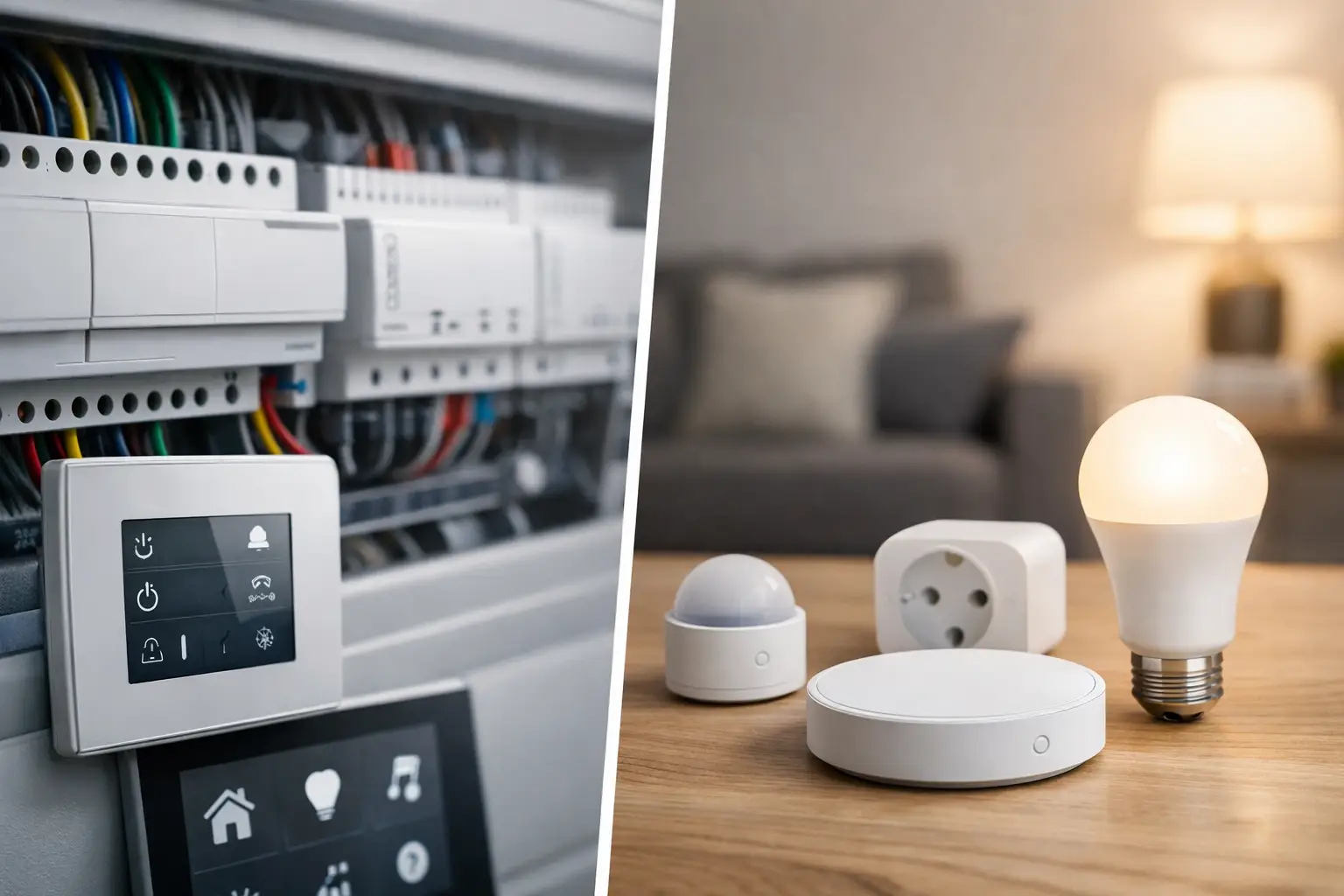
A luxury villa should not become less comfortable because a battery is flat, a wireless signal is blocked by concrete, or one device has stopped responding. That is the real decision behind KNX versus Zigbee automation. Both can bring lighting, climate, curtains, security, and entertainment into one intelligent system, but they are designed for different project priorities.
For a Dubai villa, penthouse, hotel, office, or retail space, the better choice is rarely about which technology has the longer feature list. It comes down to the property’s construction stage, system size, expected lifespan, integration requirements, and the level of certainty the owner or operator expects every day.
KNX Versus Zigbee Automation at a Glance
KNX is a professional building automation standard most commonly installed as a wired system. Dedicated bus cabling connects devices such as keypads, sensors, thermostats, actuators, and control panels. The system is planned, programmed, and tested as part of the property’s technical infrastructure.
Zigbee is a wireless communication protocol used by many smart-home devices. It creates a mesh network, where compatible powered devices can help relay signals across the property. Zigbee can be an effective option for retrofits, apartments, and targeted smart upgrades where opening walls or running new control cables would be disruptive.
Neither approach is automatically better. A compact apartment that needs smart lighting, motorized curtains, and app control may be well served by Zigbee. A large villa with multiple zones, landscape lighting, HVAC control, gates, CCTV, and a requirement for fixed wall keypads may call for KNX as the central foundation.
Why KNX Is Chosen for High-Value Properties
KNX is built for long-term building control. Rather than relying on individual consumer devices communicating through a hub, a KNX installation is designed around the entire property. Wall switches can trigger scenes, occupancy sensors can manage lighting and climate, and central logic can coordinate multiple systems according to schedules, occupancy, or security status.
Reliability Is Designed Into the Installation
Wired communication is a major reason KNX is specified for villas, hospitality projects, and commercial spaces. Signals are not competing with Wi-Fi traffic, and thick concrete walls, metal finishes, and large floorplans have less effect on communication. This matters in UAE properties, where construction materials and expansive layouts can make wireless planning more demanding.
A professionally commissioned KNX system also continues to perform core functions locally. Lighting, shading, and climate routines do not need a cloud service to operate. Remote app access can be added, but the property is not dependent on internet availability for daily control.
It Handles Complexity Without Creating More Work
A well-designed KNX system can manage many rooms and subsystems from a consistent control strategy. One bedside keypad might turn off selected lights, close curtains, adjust the air conditioning, and arm a nighttime security routine. A hotel operator can define room modes that support housekeeping, guest comfort, energy management, and maintenance.
This depth is valuable when the system has to work for several users, not just a single homeowner. Developers and facility teams can also benefit from standardized functions across multiple units or floors.
KNX Is Best Planned Early
The trade-off is that KNX is most cost-effective during construction or a substantial renovation, when cables can be installed before ceilings and finishes are completed. It also requires careful electrical design, programmed commissioning, and experienced coordination with MEP, interior, and lighting teams.
That planning is not a disadvantage when automation is part of a premium project from the outset. It is how the final experience remains clean, dependable, and easy to use. But it can be excessive for a small retrofit with limited control requirements.
Where Zigbee Makes Sense
Zigbee brings a different advantage: flexibility. Wireless smart switches, lamps, sensors, plugs, locks, and curtain motors can often be introduced with less disruption than a wired automation system. For an occupied apartment or an investment property undergoing a light refresh, that can reduce installation time and protect existing finishes.
A Practical Choice for Retrofits and Smaller Spaces
A Zigbee system is often suitable when the project needs selected upgrades rather than a fully engineered building-control platform. For example, an owner may want app-controlled lights in key rooms, a smart thermostat, door sensors, video intercom integration, and a few automated curtain tracks. If the device network is planned properly, this can create a highly convenient daily experience.
Because Zigbee devices form a mesh, powered devices can extend coverage. This can work well across an apartment or moderate-size home. However, battery-powered sensors generally do not repeat the signal, so device placement still matters.
The Limits Need to Be Understood
Wireless does not mean installation-free. Zigbee needs a compatible hub or controller, careful device selection, proper signal testing, and a clear ownership plan for apps, accounts, and updates. Mixing brands without confirming interoperability can lead to fragmented control and support challenges.
Battery maintenance is another consideration. A door sensor or motion sensor may run for a long period, but it will eventually need attention. For a homeowner this may be acceptable. For a hotel, a large villa, or a property with dozens of sensors, maintenance becomes an operational factor rather than a minor inconvenience.
Wireless range also depends on the building. Reinforced concrete, mirrors, metal cabinetry, elevator shafts, outdoor areas, and equipment rooms can affect signal paths. A professional site assessment should test these conditions instead of assuming that a device will work because it performs well in a showroom.
Performance, Cost, and Scalability
The initial price of Zigbee equipment is often lower than KNX because it avoids extensive control cabling and may use more consumer-oriented devices. This can make it attractive for targeted projects. Yet initial equipment cost is only one part of the investment.
KNX has a higher upfront cost because it includes design, cabling, panels, programming, and commissioning. Over the life of a large property, that investment can be justified by reliability, fixed controls, easier expansion planning, and a single coordinated system. It can also support a more refined interior result, with elegant keypads replacing rows of separate switches and controllers.
Scalability is not simply about adding more devices. It is about whether the system remains organized as the property evolves. A Zigbee installation can grow successfully when it is designed around a capable controller and approved devices. KNX is generally better suited to properties that begin with a large scope or are expected to add zones, buildings, specialized lighting, energy monitoring, or hospitality functions over time.
Choosing the Right Architecture for Your Property
The most effective projects do not treat KNX and Zigbee as competing labels. They begin with how the building will be used. A family villa needs intuitive scenes, dependable climate control, perimeter security, and simple handover for every household member. A penthouse may prioritize discreet controls, architectural lighting, curtains, and remote access. A restaurant may need lighting moods, music zones, occupancy-driven back-of-house control, and reliable opening and closing routines.
In some cases, a hybrid approach is the right answer. KNX can manage the critical wired infrastructure, while selected wireless devices serve locations where cabling is impractical. The key is ensuring that the platform is designed as one coordinated experience, not a collection of disconnected apps.
Before selecting technology, define the rooms and systems to be controlled, the construction stage, the desired wall-control experience, remote-access requirements, maintenance expectations, and future expansion plans. Then assess the electrical drawings, finishes, network coverage, and equipment locations. This avoids expensive changes after installation has begun.
Esmartech approaches this process through consultation, clear system design and quotation, professional installation, testing, and user handover. That structure gives owners and project teams a single accountable partner from the first decision through daily use.
The right automation system should disappear into the way a property operates: lights respond when needed, rooms stay comfortable, security is easier to manage, and every control feels natural. Choose KNX when the project demands engineered, wired certainty at scale. Choose Zigbee when flexible, carefully planned wireless control suits the space. The best result comes from matching the architecture to the property, not forcing the property to fit the technology.


Leave a comment