
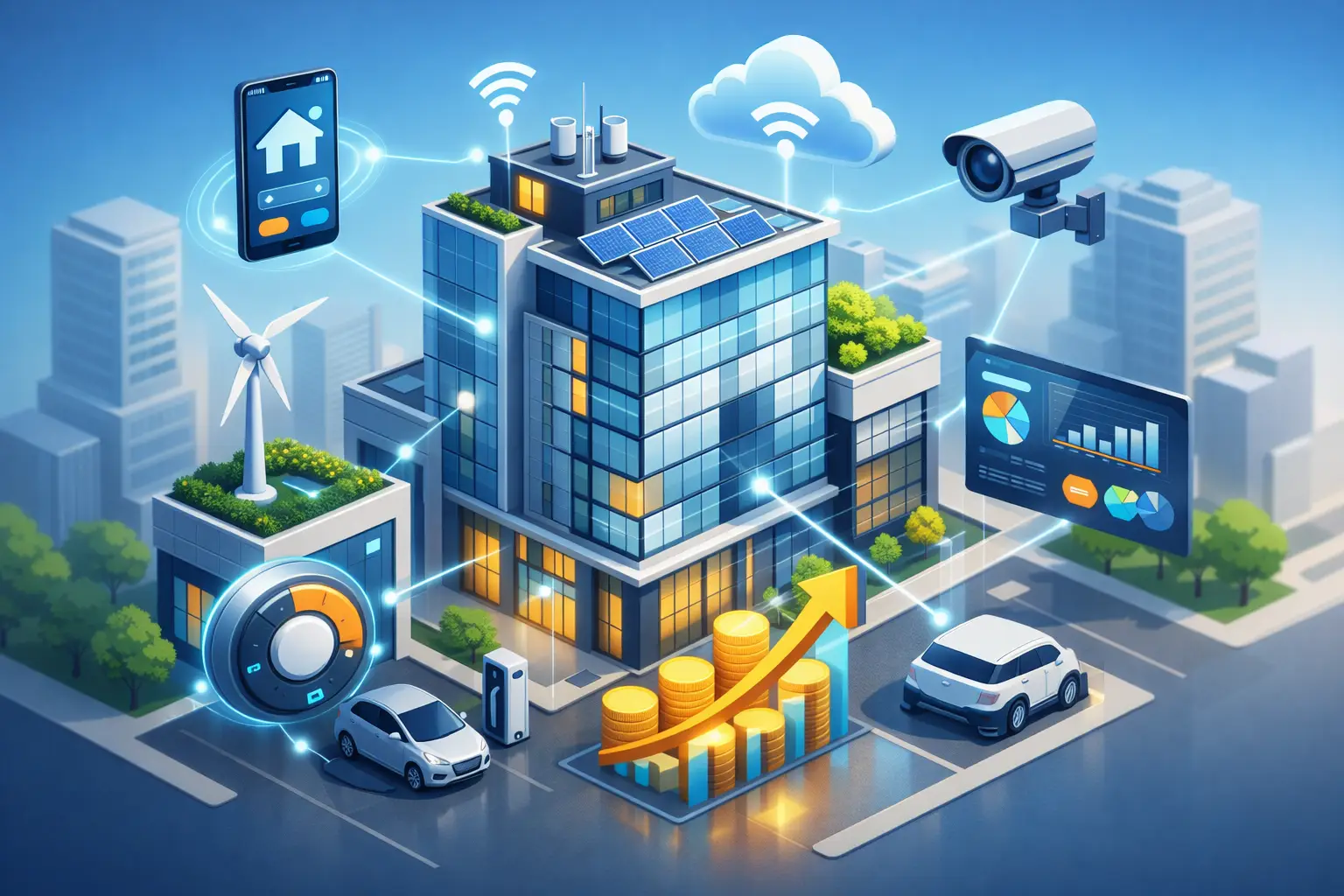
A premium property should not require separate remotes, disconnected security apps, and constant manual adjustments to stay comfortable. Smart building technology 2026 is moving beyond isolated gadgets toward one intelligent system that manages how a villa, apartment, hotel, office, or retail space actually operates.
For property owners in the UAE, the value is practical. Air conditioning can respond to occupancy and time of day. Lighting can support the mood of a residence or the operating schedule of a restaurant. Access, CCTV, intercoms, curtains, entertainment, and energy use can be managed from a central interface. The best result is not more technology on display. It is a property that feels easier to live in, manage, and protect.
Smart Building Technology 2026: The Shift to Connected Operations
The most significant change is the move from device-level convenience to property-level control. A smart lock on its own solves one task. A thermostat on its own solves another. When these systems are properly designed together, they can support routines that make sense for the building and the people using it.
In a villa, an Away scene might turn off selected lights, adjust cooling setpoints, close curtains, arm security zones, and notify the homeowner if a door remains open. In a hotel, room status, guest comfort, housekeeping access, and energy-saving settings can be coordinated without creating a complicated experience for staff or guests. In an office, meeting-room occupancy can inform lighting, climate, and audiovisual control.
This is why system design matters more than a long list of products. Building automation should follow the property’s daily patterns, user roles, finishes, network capability, and future plans. A penthouse owner needs intuitive personal control. A facilities manager needs visibility, permissions, reporting, and reliable operation across many spaces. They may use similar technologies, but they should not receive the same design.
AI becomes useful when it supports clear decisions
Artificial intelligence is becoming part of smart building conversations, but it should be assessed with discipline. Its most useful role is often pattern recognition: identifying unusual energy consumption, learning preferred temperature ranges, flagging equipment behavior that needs attention, or helping staff respond to service requests faster.
It should not replace well-planned controls or create a system that owners cannot understand. A building must still work predictably when internet service is interrupted, when a resident prefers manual control, or when staff need to override a scheduled setting. Automation should make decisions easier, not hide them behind an unclear algorithm.
For this reason, the strongest projects combine intelligent recommendations with simple, visible control. A wall keypad, touch panel, app, voice command, and scheduled scene should work together without forcing every user into the same method.
Energy Management Will Be a Core Investment Decision
In a climate where cooling is a major operating cost, smart climate control has become one of the clearest reasons to invest in building technology. The goal is not simply to lower temperatures remotely. It is to cool occupied areas appropriately while avoiding unnecessary demand in empty rooms or unused zones.
Occupancy sensors, door and window contacts, programmable scenes, and integrated thermostats can help a property respond to real conditions. A guest room can return to an efficient setting after checkout. A villa can reduce cooling in unoccupied bedrooms during the day. A retail space can prepare its front-of-house environment before opening, then shift into a lower-use mode after closing.
The savings vary by property size, insulation, equipment condition, operating hours, and user behavior. Any provider promising a fixed percentage before understanding the site should be treated cautiously. Still, the operational benefit is broader than utility reduction. Better control can reduce staff interventions, prevent waste caused by open doors or forgotten settings, and give owners a clearer picture of how the property performs.
Lighting control supports the same objective. Dimming, occupancy response, daylight adjustment, and scene control can create a polished atmosphere while limiting unnecessary use. In luxury residences, this protects the look of carefully selected lighting. In hospitality and commercial environments, it helps maintain consistency across guest-facing areas.
Security Is Becoming More Integrated, Not More Complicated
Security systems are most effective when they are easy to use every day. A property owner should be able to see who is at the gate, speak through an intercom, grant access when appropriate, review cameras, and receive relevant alerts without moving between multiple platforms.
In 2026, integrated access control is especially valuable for properties with different user groups. A villa may need separate permissions for family members, household staff, drivers, and maintenance teams. A commercial property may need time-based access for employees, contractors, and delivery personnel. Hotels need a structure that protects guests while allowing operations to continue efficiently.
The right level of security depends on the risk profile of the site. More cameras are not automatically better if coverage is poorly planned or footage is difficult to retrieve. Facial recognition may suit certain managed environments but can raise privacy, policy, and user-acceptance questions. A professional assessment should identify entry points, vulnerable areas, lighting conditions, access requirements, and the need for backup power or local recording.
Integration also improves the response to everyday events. If an access door is opened outside approved hours, the system can trigger a notification, activate selected lights, or direct a camera view to the relevant zone. The purpose is timely awareness, not unnecessary alarms.
Wired and Wireless Systems Both Have a Place
One of the most common mistakes in smart building planning is treating wired and wireless technology as competing choices. In reality, the best architecture depends on whether the project is a new build, a full renovation, or an occupied property.
Wired infrastructure remains an excellent option for large villas, high-end developments, hotels, and commercial projects where reliability, speed, and long-term expansion are priorities. It allows control components to be planned early, keeps key systems organized, and reduces dependence on wireless signals across extensive spaces.
Wireless systems can be highly effective for apartments, completed villas, phased upgrades, and projects where opening walls is not practical. They can bring meaningful control to an existing property with less disruption. However, they still require professional planning for device placement, network coverage, power, interoperability, and future support.
A hybrid design is often the sensible choice. Core systems such as lighting panels, network equipment, and security infrastructure may benefit from wired connections, while selected controls or sensors can be added wirelessly. The decision should be based on performance and lifecycle needs, not on a one-size-fits-all preference.
What Owners Should Ask Before Choosing a System
The best time to make automation decisions is before ceilings close, finishes are installed, and furniture layouts are finalized. Even so, a completed property can still be upgraded successfully with the right approach. The first question is not which app looks best. It is how the building needs to work.
Owners and project teams should establish the priority areas early: climate, lighting, security, access, curtains, audio, entertainment, energy management, or all of the above. They should also consider who will use the system, whether remote access is required, what should continue operating during an internet outage, and how the property may expand later.
It is also worth asking who takes responsibility after installation. A smart property is not complete when devices are mounted. Controls must be programmed, tested across realistic scenarios, clearly labeled where needed, and explained to the people who will use them. Documentation and support are part of the investment, particularly in larger residences and commercial environments where staff turnover can affect daily operation.
A Better Project Process Creates a Better Result
High-quality automation begins with a site consultation. This is where the design team reviews drawings or walks the property, understands lifestyle or operational requirements, checks existing infrastructure, and identifies potential limitations before they become costly changes.
The next stage should be a clear quotation and system design. Property owners should be able to see what is included, how systems will be controlled, what equipment is proposed, and where future expansion remains possible. Premium technology should not be presented as a mystery. The design should make the experience and the investment understandable.
Installation then needs to be coordinated with electrical, interior, HVAC, IT, security, and fit-out work. Clean cable management, correctly positioned sensors, well-planned keypads, tested network coverage, and careful commissioning all affect how the finished system performs. At handover, users need practical guidance tailored to their role, whether that is a homeowner, concierge, office manager, or facilities team.
For owners who want one accountable partner, Esmartech can manage this journey from consultation and system design through installation, programming, testing, and handover. The aim is straightforward: technology tailored to the space and its users, with control that remains clear long after the project is complete.
The right smart building investment is rarely the one with the most features. It is the one that quietly supports comfort, security, energy awareness, and daily routines while leaving the property ready for what comes next.


Leave a comment