
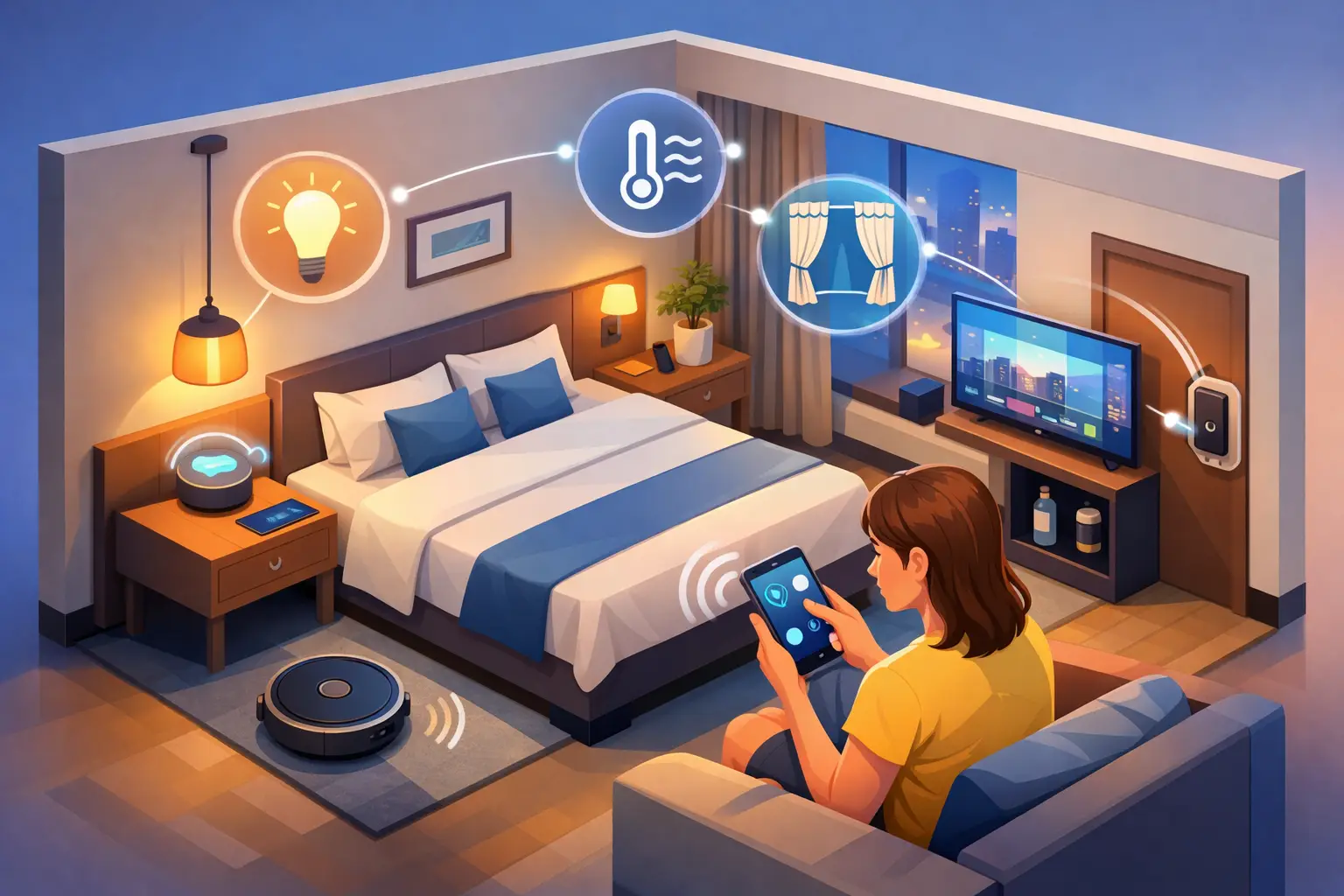
A guest arrives after a late flight, opens the door with a mobile credential or keycard, and the room responds at once: welcoming lights come on, the temperature moves to a preferred setting, and the curtains remain closed for privacy. Nothing feels technical because hotel room automation has removed the small points of friction before the guest notices them.
For hotel operators, that same room can reduce unnecessary cooling when vacant, alert staff to maintenance concerns, and give management a clearer view of room status across the property. The value is not found in adding more devices. It comes from designing one intelligent system around how guests stay and how hotel teams operate.
What Hotel Room Automation Should Deliver
A well-designed automated guest room should make the room easier to use than a conventional one. Guests should not need to download an app, search for instructions, or understand multiple remotes just to lower the temperature or close the curtains. Physical keypads, intuitive bedside controls, touch panels, voice control where appropriate, and mobile access can work together, but each should have a clear purpose.
The most successful systems start with the guest journey. Arrival mode can activate selected lighting and climate settings. A bedside “good night” control can turn off lights, close curtains, and set the air conditioning to a comfortable sleeping temperature. On departure, the room can return to an energy-conscious unoccupied mode without compromising the guest experience.
Automation also gives operations teams useful control behind the scenes. Occupancy and door sensors can help distinguish between a vacant room, an occupied room, and a room that requires attention. Housekeeping and maintenance teams can receive the right status information without interrupting guests unnecessarily. Centralized control allows authorized staff to monitor selected systems and respond faster when an issue is reported.
The Systems That Matter Most in Guest Rooms
Hotel rooms do not need every available smart feature. They need reliable systems that support comfort, privacy, security, and efficient operations. The right mix depends on the hotel category, room type, building infrastructure, and service model.
Lighting and scene control
Lighting scenes give a room a more considered, premium feel. Instead of relying on a row of unrelated switches, guests can select simple settings such as Welcome, Relax, Work, Night, or All Off. In suites, scenes can also coordinate lighting across the living area, bedroom, bathroom, and balcony.
For operators, automated lighting avoids unnecessary consumption in unoccupied rooms and back-of-house areas. The design still needs practical manual control. Guests expect immediate access to lights at the entry, bedside, and bathroom, even if network services are temporarily unavailable.
Climate control and energy management
Air conditioning is often one of the largest energy loads in hospitality properties, particularly in warm climates. Smart thermostats, occupancy sensing, door and window contacts, and programmed temperature limits can prevent rooms from being cooled aggressively when they are vacant or when a balcony door is open.
However, energy savings should never make a room feel uncomfortable. An overly aggressive setback can create a hot, humid room before a new arrival, leading to complaints and additional work for front desk teams. A better approach uses booking status, check-in timing, occupancy data, and local weather conditions to prepare rooms intelligently.
Curtains, shades, and privacy
Motorized curtains and blinds add convenience while helping manage daylight, privacy, and heat gain. Guests can close blackout curtains from the bed, while daytime settings can bring in natural light without exposing the room to excessive solar heat.
In luxury rooms and suites, curtain control is particularly valuable when integrated into scene settings. Still, the system should be quiet, appropriately sized for the fabric and track, and fitted with accessible local controls. A beautiful automated curtain that is slow, noisy, or difficult to override will not feel premium.
Access control and smart locks
Smart locks can support keycards, mobile credentials, and controlled staff access. When integrated correctly, access events can support guest safety and operational awareness. A front desk can issue or revoke credentials efficiently, while authorized teams can enter only during approved service windows.
Security design must remain disciplined. Guest-room access should not be treated like a consumer smart lock installation. Hotels need reliable credential management, audit trails, secure network planning, emergency access procedures, and a clear process for handling lost devices or cards.
Service, occupancy, and maintenance signals
Simple room-status controls such as Do Not Disturb, Make Up Room, and Service Request can reduce calls and corridor disruptions. Sensors can also identify conditions that deserve attention, including prolonged door opening, water leaks, abnormal temperatures, or equipment faults.
The goal is not to monitor guests. It is to give hotel teams better visibility into the building systems they are responsible for. Privacy policies, data retention, and staff permissions should be established before deployment, especially when mobile apps or occupancy analytics are involved.
Hotel Room Automation Is an Operations Project
The technology inside the room is only one part of the decision. A hotel automation project affects interior design, electrical work, HVAC controls, IT infrastructure, front desk procedures, housekeeping routines, and maintenance support. Treating these as separate workstreams often creates costly gaps at handover.
For example, a guest room controller may need to communicate with the building management system, the property management system, door locks, and the hotel network. The integration should be defined early, including which system is the source of truth for room occupancy, check-in status, alarms, and staff access. Not every hotel needs every integration, but every integration should have a measurable operational purpose.
Wired automation is often the strongest choice for new-build hotels and major renovations because it supports dependable, centralized infrastructure across many rooms. Wireless solutions can be effective for phased upgrades or properties where opening walls and ceilings would be disruptive. The right architecture depends on the building, budget, timeline, and requirement for future expansion.
A single hotel room prototype is valuable before a full rollout. It gives the operator, designer, facilities team, and housekeeping staff a chance to test switch locations, lighting levels, keypad labels, climate behavior, curtain speed, and service workflows under real conditions. Adjusting these details in one mock-up room is far easier than correcting them across 200 rooms.
How to Plan the Right System
Start with the guest experience your property wants to provide. A business hotel may prioritize fast room entry, dependable climate control, bedside charging, and clear work lighting. A resort may place greater emphasis on scene lighting, blackout shades, outdoor controls, and personalized comfort. A luxury suite may require integrated entertainment, audio, multiple zones, and discreet staff controls.
Then define the operational outcomes. These might include reducing energy use in vacant rooms, shortening maintenance response times, improving room readiness visibility, or centralizing control for facilities managers. Clear outcomes prevent expensive features from being added simply because they are available.
The next step is a detailed site consultation and system design. This should review electrical panels, HVAC equipment, network coverage, door hardware, ceiling access, room layouts, interior finishes, and the systems already specified by the project team. The design must show not only what will be installed, but also how it will be tested, supported, and handed over.
For hospitality projects in Dubai and across the UAE, Esmartech can coordinate this process from consultation and clear quotation through installation, programming, testing, staff guidance, and ongoing support. Having one accountable integration partner helps reduce the risk of separate contractors leaving unresolved issues between lighting, climate, access, and control systems.
Common Mistakes That Reduce Guest Satisfaction
The first mistake is prioritizing technology over clarity. A room with too many touchscreens, remotes, apps, and unlabeled controls can feel less convenient than a standard room. Guests need a few immediate, visible controls, supported by automation working quietly in the background.
The second is designing only for check-in. A good arrival scene matters, but so do middle-of-the-night bathroom lighting, quiet curtain operation, comfortable sleeping temperatures, and one-touch departure settings. The details that guests experience repeatedly carry more weight than a dramatic first impression.
The third is overlooking support after opening. Batteries, network equipment, firmware, sensors, control interfaces, and integrations all need a practical maintenance plan. Hotel teams should receive role-based training, simple troubleshooting guidance, and a clear route for escalation when a room fault affects a guest.
Finally, avoid locking the property into a system that cannot grow. Hotels renovate rooms, add services, update access credentials, and change operating procedures. A scalable design allows future upgrades without requiring the entire guest-room control platform to be replaced.
The best hotel room is one guests understand instinctively and staff can manage with confidence. When automation is tailored to the property rather than added as a collection of gadgets, it becomes part of the hospitality experience: quiet, dependable, comfortable, and ready when it is needed.



Leave a comment