
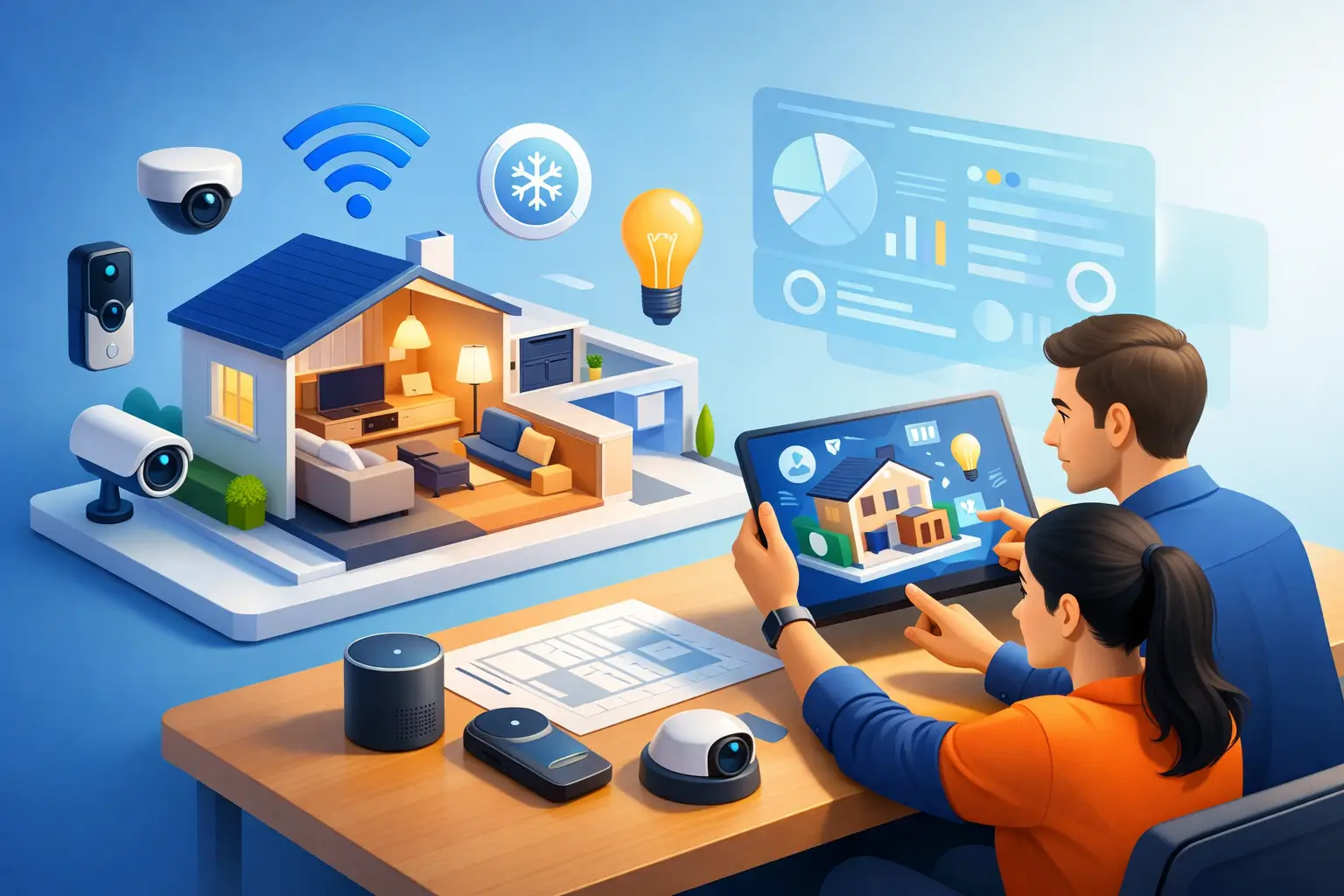
A luxury villa can have beautiful finishes, premium appliances, and a strong security package yet still feel complicated to operate. Lights may use separate apps, air conditioning may run longer than necessary, curtains may need manual control, and family members may have different ideas about how the home should work. A smart home consultation is where those disconnected decisions become one intelligent system tailored to the property, the people using it, and the way it will be managed over time.
For a Dubai villa, penthouse, apartment, hotel, office, or restaurant, consultation is not a sales presentation for individual devices. It is the planning stage that determines whether automation will be genuinely useful after handover. The right plan considers architecture, wiring, daily routines, security priorities, interior design, budget, and future expansion before equipment is selected.
Why a smart home consultation comes first
Smart technology is often discussed as a collection of products: smart locks, voice assistants, cameras, thermostats, motorized curtains, and speakers. Each can solve a narrow problem. A professionally designed automation system solves the larger question: how should the entire property respond when someone arrives, leaves, entertains guests, checks in remotely, or closes for the night?
That distinction matters. Adding devices room by room can create duplicate controls, unreliable wireless coverage, inconsistent finishes, and several apps that no one wants to open. A consultation identifies which systems should communicate with each other and which should remain independent. It also prevents spending on features that sound impressive but do not fit the property’s operating requirements.
For example, a family villa may prioritize intuitive scene controls, perimeter security, bedroom climate comfort, pool-area lighting, and remote access for household staff. A penthouse owner may place greater emphasis on discreet keypads, motorized shading, entertainment, and protecting interior aesthetics. A hotel or office may need centralized monitoring, access permissions, energy schedules, and controls that are simple for staff to learn.
The technology may overlap, but the design should not be copied from one property to another.
What happens during a smart home consultation
A useful consultation starts with how the space is used, not with a catalog of products. The integration team reviews the site, listens to priorities, and maps the systems that need to work together. On a new build or renovation, this should happen early enough to coordinate electrical points, network locations, ceiling access, equipment cabinets, and control interfaces with the architect, interior designer, MEP contractor, and builder.
In a completed home, the focus may shift toward practical upgrade paths. Wireless automation can be an excellent solution where opening walls is undesirable, while wired systems are often preferred for large villas, new construction, and projects requiring extensive reliability and control. Neither approach is automatically better. The right architecture depends on the building fabric, the number of systems involved, desired performance, and available budget.
Understanding the property and its routines
The first discussion should cover more than room count. A professional team will ask how residents enter the home, which areas are occupied most often, whether children, guests, or staff need different access levels, and how often the property is vacant. They may review outdoor areas, service entrances, parking, gates, guest rooms, home cinemas, and other spaces that are frequently overlooked.
Daily routines are equally valuable. One household may want a morning scene that raises selected curtains, adjusts bedroom temperature, and turns on pathway lighting. Another may want one button at the entrance that powers down nonessential systems, arms security, and confirms that doors are locked. These scenarios shape the programming far more effectively than choosing controls by appearance alone.
Reviewing infrastructure before making promises
A consultation should include an honest assessment of the existing electrical and network infrastructure. Wi-Fi quality, router position, wall construction, electrical panel capacity, and cable pathways affect what can be installed cleanly and how consistently it will perform.
This is especially important in larger properties. Cameras, access control, audio, climate controls, and connected lighting all depend on a sound network strategy. A premium automation interface cannot compensate for weak coverage or poorly planned equipment locations. Reviewing this early helps protect the project from delays, visible retrofit work, and unnecessary change orders later.
Defining control, security, and privacy
Convenience is only one part of intelligent control. A smart home consultation should establish who can operate what, from where, and under which conditions. Residents may need full app and voice control, while guests might only use elegant wall keypads. Staff may require access to selected service areas without receiving entry permissions for private rooms.
Security planning may include CCTV, video intercoms, gate automation, smart locks, door contacts, motion sensors, and alerts. The goal is not simply to install more cameras. It is to create clear visibility and sensible response options without making the property difficult to live in. Privacy also deserves direct discussion, particularly when cameras, microphones, cloud services, and remote access are involved. A capable integrator can explain how the system is configured and what access is retained by the owner.
From ideas to a clear project scope
After the site review, the consultation should lead to a structured system design and quotation. This is where broad goals become practical decisions: which rooms receive lighting control, where switches and touch panels will sit, how curtains will be grouped, which areas need audio, and whether climate settings should be room-by-room or zone-based.
A good proposal makes the scope understandable. It should distinguish essential infrastructure from optional enhancements and explain the role of each system. It should also show how the property will be controlled, whether by keypads, touch panels, a centralized app, voice commands, or a combination of methods.
Price matters, but comparing proposals only by the number of devices can be misleading. Two quotations may both include lighting, climate, and security, while offering very different levels of programming, network preparation, finish quality, commissioning, and support. The lower upfront cost may be reasonable for a compact apartment with limited requirements. For a large residence or hospitality project, reducing design and testing time can create operational problems that cost more to correct later.
Questions worth asking before approving the design
The consultation is also the right time for owners and project stakeholders to test the quality of the proposed solution. Ask how the system behaves if internet service is unavailable, what happens during a power interruption, and whether essential controls continue to work manually. Ask who is responsible for coordinating with other contractors, managing cable labels, testing every scene, and resolving issues before handover.
It is worth clarifying scalability as well. A first-phase system may focus on lighting, air conditioning, curtains, access, and CCTV, with entertainment or additional rooms planned later. That approach can be sensible, provided the underlying infrastructure and control platform are chosen with expansion in mind. Planning for growth is different from paying for features that will never be used.
For commercial and hospitality properties, ask about user permissions, reporting needs, maintenance procedures, and staff training. A restaurant manager should not need technical expertise to adjust zones for service, while a hotel operator may require clear controls across multiple rooms and common areas. The best system is sophisticated behind the scenes and straightforward at the point of use.
Installation, programming, and handover are part of the consultation promise
A design is only as good as its execution. The consultation should establish a path from approved quotation to installation, programming, testing, and user guidance. This is particularly important when automation intersects with interior finishes, security contractors, HVAC specialists, and AV teams.
Esmartech manages this process as a single accountable partner, from site assessment and system design through clean installation, commissioning, and handover. That accountability matters because a control issue may involve more than one trade. The homeowner or project manager should not have to determine whether a problem belongs to the electrician, network contractor, curtain supplier, or automation programmer.
At handover, users should be shown how to operate the system in everyday terms. They should know how to adjust a room manually, use the app away from home, manage access permissions, and request support. Testing should confirm that scenes, schedules, cameras, intercoms, locks, climate settings, and entertainment controls perform as intended in real conditions, not merely in a demonstration.
The result should feel natural, not technical
The measure of a successful smart property is not how much technology is visible. It is how little effort the technology requires from residents, guests, staff, or managers. A well-planned system brings lighting, climate, security, shading, audio, and access into a clear control experience while preserving familiar manual options where they make sense.
Before selecting devices, give the consultation enough attention to reflect the value of the property and the expectations of those using it. The strongest result is not a home filled with gadgets. It is a space that responds calmly, securely, and reliably to the life happening inside it.


Leave a comment