
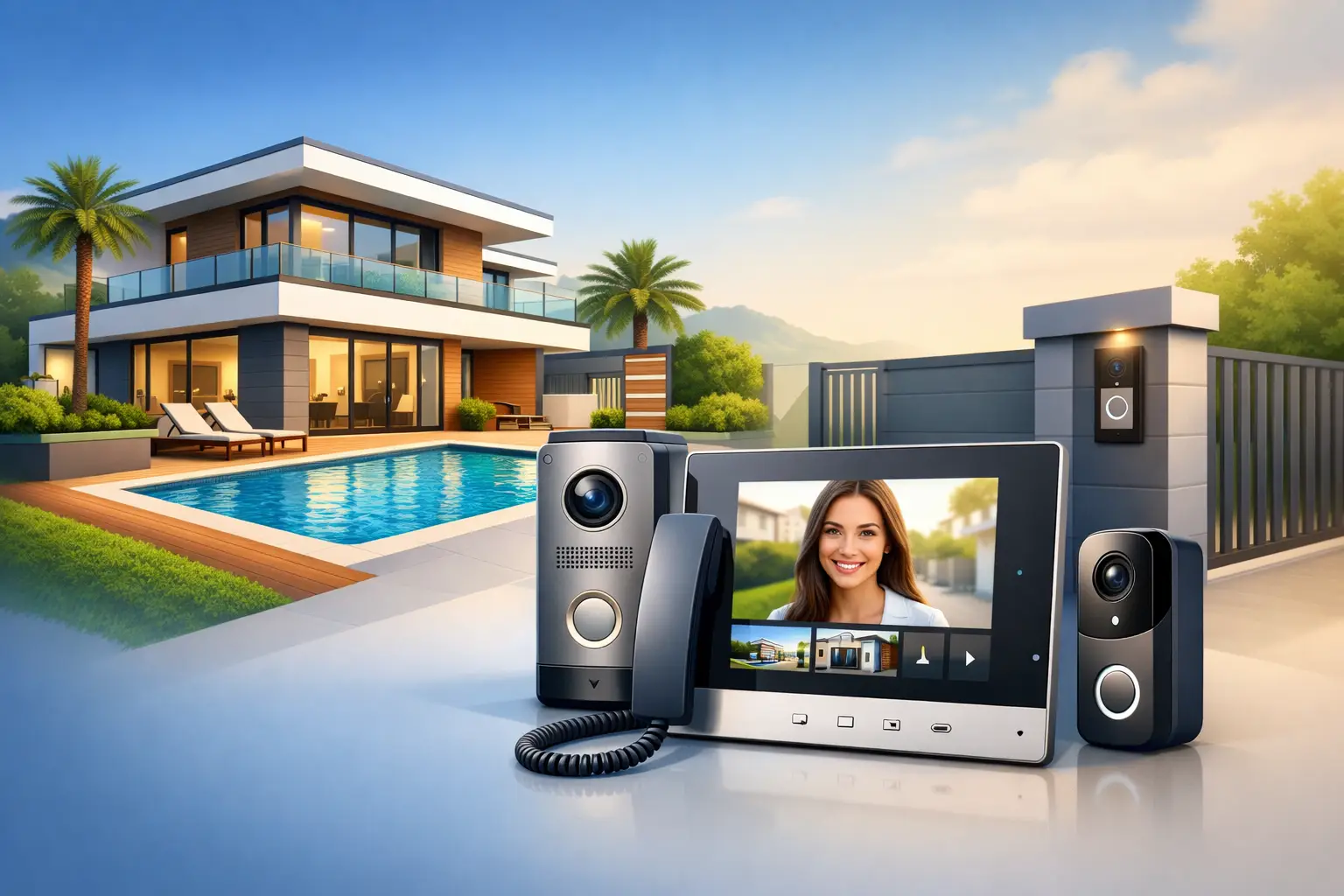
A villa gate is more than a boundary. It is where family members return home, deliveries arrive, guests are welcomed, and service staff request access. A well-designed video intercom system for villas turns this busy point of entry into a controlled, visible, and convenient part of the home rather than a weak spot in its security.
For Dubai villa owners, the right system needs to do more than show a caller on a screen. It should work reliably in outdoor heat, support the way the household actually operates, and fit naturally with gates, doors, CCTV, smart locks, and the wider smart-home platform. The difference lies in planning the system around the property, not simply mounting a door station at the gate.
What a Villa Video Intercom Should Do
At its core, a video intercom lets residents see and speak with a visitor before granting entry. An outdoor station with a camera, microphone, speaker, call button, and often a keypad or card reader communicates with indoor touchscreens, mobile phones, or both. When a visitor calls, the homeowner can verify who is at the gate, speak with them, and release the pedestrian gate, vehicle gate, or main door where authorized.
That basic function becomes more valuable in a larger property. A villa may have a perimeter entrance, a separate staff entrance, a garage, a service yard, several floors, and multiple family members with different access needs. A properly specified intercom system can direct calls to selected rooms, display the gate camera on several touch panels, and allow approved users to respond from their phones when they are away.
The goal is not to add another app or another screen that the household must manage. It is to create one intelligent system in which entry is simple for residents and carefully controlled for everyone else.
Start With the Villa’s Entry Points and Daily Routine
The best design begins with a site consultation. Before choosing a brand, screen size, or camera style, consider how people enter and move through the property. A family that regularly receives guests and deliveries has different needs from a villa used mainly on weekends. A property with live-in staff requires a clearer access structure than one occupied only by the owners.
The main gate is usually the priority, but it should not be the only point considered. Secondary gates, side entrances, staff areas, pool access, basement doors, and driver or maintenance entry points can all affect the final system design. If these locations are overlooked at the start, the result may be separate devices with inconsistent permissions and no clear record of who can enter where.
It also helps to decide how calls should be handled. Some homeowners want the gate call to ring on a wall-mounted screen in the living area and master bedroom. Others want calls routed to a phone when nobody is home. For larger villas, calls may need to reach a guard room, reception point, or designated staff member first. These choices are practical details, but they determine whether the system feels effortless or disruptive.
Choose Security Features That Match Real Risks
Video quality matters, particularly at gates where sunlight, shadows, headlights, and nighttime conditions can make faces difficult to identify. Look for a camera angle that captures visitors clearly without pointing too high or too low. Wide-angle coverage is useful, but an extremely distorted image can make identification less reliable. Low-light performance, infrared capability, and a well-positioned gate light often matter more than headline resolution alone.
Two-way audio should be clear enough for a natural conversation at the gate. Noise from roads, landscaping equipment, and air conditioning units can affect performance, so outdoor placement and hardware quality deserve attention. A call button should be easy for guests to find, while the unit itself should be protected from weather, tampering, and direct exposure where possible.
Access credentials are another design decision. A keypad can be convenient for temporary visitor codes, while RFID cards or tags suit household staff and regular service providers. Mobile credentials can give owners control without distributing physical keys. For high-security properties, the intercom may work alongside gate automation, biometric access, smart locks, and CCTV recording rather than replacing any of them.
Remote gate release is useful, but it should be configured with care. The homeowner should be able to confirm the visitor visually before releasing access, and different users should have permissions appropriate to their role. For example, a house manager may need access to the service gate but not the main entrance after certain hours. Good access control is not about making every door harder to open. It is about making the right doors easy for the right people to use.
Wired or Wireless: Make the Decision Early
For a new villa build or major renovation, a wired intercom system is often the strongest long-term choice. Structured cabling supports dependable communication, stable video, centralized power options, and straightforward integration with other low-voltage systems. It also leaves room to expand later, whether that means adding another internal monitor, a second gate station, or integrated access control.
Wireless solutions can be practical for completed villas where opening walls or landscaping would be disruptive. They can reduce installation time and may suit a smaller scope, such as adding video verification to a single entrance. However, wireless performance depends on signal strength, distance, building materials, and the layout of the property. Thick concrete walls, metal gates, and large outdoor areas can complicate coverage.
Neither approach is automatically right for every project. The appropriate architecture depends on the property’s condition, the desired level of integration, future plans, and budget. A professional survey can identify cable routes, network requirements, equipment locations, and any constraints before installation begins.
Connect the Intercom With the Systems You Already Use
A standalone video doorbell may be sufficient for a compact home with one entry point. In a luxury villa, integration usually delivers a better ownership experience. The intercom can be connected to gate motors, electric strikes, smart locks, indoor touch panels, CCTV cameras, and a centralized mobile app.
This means a resident may receive a gate call on the same interface used for lighting, curtains, climate control, and security. When the outdoor station is activated, the system can display the relevant camera view and provide authorized release controls. If a visitor arrives after dark, an automation can turn on selected entrance lighting while the homeowner verifies the caller.
Integration should remain purposeful. It is not necessary to automate every possible response. A sensible design focuses on useful actions, clear user interfaces, and dependable operation. For example, opening the main gate from an indoor panel may be valuable every day. Creating a complicated series of automated scenes for routine deliveries may add more confusion than convenience.
Plan for Privacy, Reliability, and Support
A video intercom handles sensitive information: images of visitors, conversations at the gate, access credentials, and household routines. The system should be installed on a secure network with properly managed user accounts and strong passwords. Remote access should be configured only for approved users, and former staff or tenants should have their credentials removed promptly.
Reliability also depends on the details behind the screen. Outdoor equipment must be selected and installed for local conditions. Gate controllers need suitable power arrangements and safe release logic. Network equipment should be located and configured correctly, especially if mobile viewing is required. During handover, every call point, screen, credential, release action, and remote function should be tested in real conditions.
The homeowner and relevant staff should also receive clear guidance. They need to know how to answer a call, issue or remove a temporary code, use remote access, and respond if a gate does not open. Technology should make daily life easier from the first day, not require repeated troubleshooting.
A Better Way to Deliver a Villa Intercom Project
A quality installation follows a clear process: consultation, quotation and design, installation and testing, then handover. This approach avoids the common problem of selecting hardware first and discovering later that it does not fit the gate, network, power supply, or wider automation plan.
Esmartech designs video intercom and access solutions around each property’s layout, lifestyle, and security requirements. For homeowners building a new villa, renovating an existing residence, or upgrading an older gate entry system, a coordinated design can protect the property while keeping arrival and access easy for the people who belong there.
The right intercom is the one that gives you a clear answer before the gate opens, whether you are relaxing upstairs, working across town, or traveling abroad.

Leave a comment