
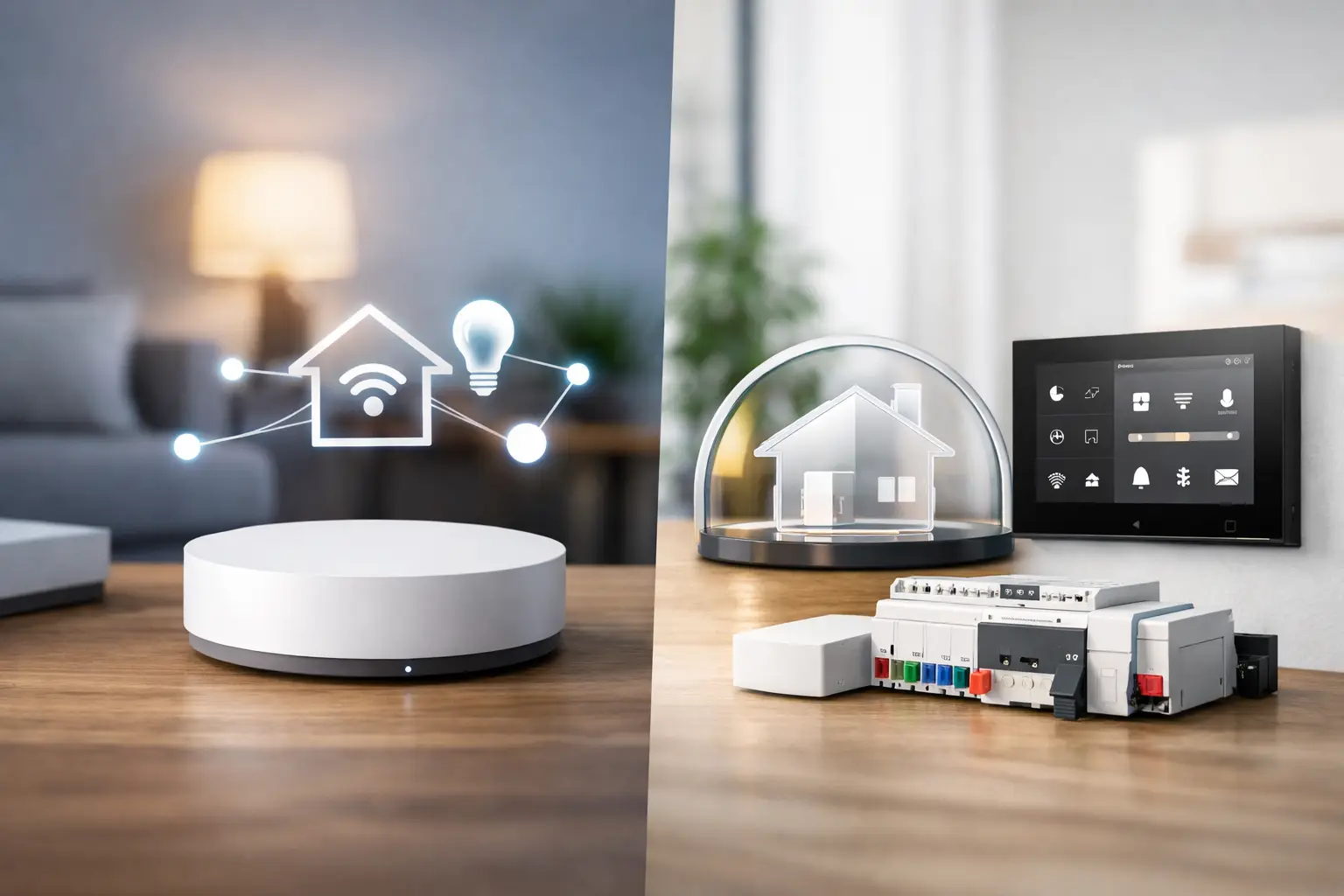
A villa can have beautiful smart switches, motorized curtains, voice control, and a polished app – yet still become frustrating if the technology behind it was chosen for convenience rather than the way the property will operate. The Matter versus KNX decision is not simply about selecting a smart-home brand. It is about deciding whether your automation should be centered on flexible consumer-device compatibility, a dedicated building-control backbone, or a carefully designed combination of both.
For Dubai villas, penthouses, hotels, offices, and high-value developments, that distinction affects reliability, control options, maintenance, and the scope for future upgrades. The best answer depends on the property, its systems, and the level of performance expected every day.
Matter versus KNX: Two Different Starting Points
Matter is a relatively new interoperability standard created to help smart devices from different manufacturers work together more easily. A Matter-compatible device can communicate through an IP-based network using Wi-Fi, Ethernet, or Thread, depending on the product. It is designed to make everyday devices such as bulbs, plugs, locks, sensors, thermostats, blinds, and selected appliances easier to add to a smart-home ecosystem.
Its appeal is clear. Owners can have more freedom to choose compatible products, control devices locally through supported platforms, and avoid being limited to a single consumer brand. Matter can be particularly useful in apartments, renovation projects, or smaller systems where wireless installation and straightforward device expansion are priorities.
KNX starts from a different place. It is an established building-automation standard used for professional control of lighting, climate, shading, energy management, security interfaces, and other building functions. KNX can use dedicated wired cabling, known as KNX TP, as well as IP and RF options. In premium projects, wired KNX is often selected because it creates a purpose-built control infrastructure that is separate from the property’s ordinary Wi-Fi network.
Put simply, Matter is primarily focused on making compatible smart products communicate. KNX is built to coordinate building systems as one intelligent system.
Where the Matter vs. KNX Choice Matters Most
Reliability is more than app access
A homeowner should be able to turn lights on from a phone, but a professionally automated property must also work when the phone is unavailable, the internet is down, or a wireless signal is crowded. Wall switches, occupancy sensors, programmed scenes, schedules, and climate logic should continue operating predictably.
Matter supports local control, which is a major improvement over cloud-dependent smart devices. However, many Matter products still rely on Wi-Fi, Thread border routers, hubs, mobile platforms, and the quality of the home network around them. This can be perfectly suitable for selected devices, especially in a well-designed apartment or retrofit.
A wired KNX system is typically more appropriate where critical functions need dependable, consistent performance across a large property. Lighting scenes in a villa, centralized AC control, curtain schedules, exterior lighting, and common-area automation can be programmed to operate independently of consumer apps or internet services. The result is not just convenience. It is operational confidence.
Scale changes the recommendation
Matter is well suited to starting small. An owner may begin with a few smart lights, a lock, sensors, and thermostats, then add compatible products later. That flexibility is valuable when walls cannot be opened or when the project budget is focused on a limited number of rooms.
KNX becomes more compelling as the number of circuits, zones, and control requirements increases. A luxury villa may include dozens of lighting circuits, multiple AC zones, motorized curtains, landscape lighting, pool equipment interfaces, gate access, intercoms, and security-related functions. A hotel or office can have even more demanding requirements, with occupancy-based control, centralized monitoring, meeting-room scenes, and energy-conscious operation.
For these environments, a system needs structure. KNX allows professional programming around how the building is actually used, rather than treating every device as an isolated smart accessory.
Wiring affects both cost and capability
The practical dividing line is often the project stage. During new construction or a major renovation, installing KNX cabling before ceilings and walls are completed is usually the most sensible option. The upfront investment can be higher than installing standalone wireless devices, but it gives the property a durable foundation for integrated automation.
In a finished apartment or occupied villa, opening walls may not be desirable. Matter-enabled devices, wireless controls, and carefully selected bridges can reduce disruption and provide meaningful improvements quickly. This does not make Matter automatically the better technology. It means the installation method needs to match the realities of the site.
There are also hybrid projects. A property may use KNX for core lighting, climate, shading, and centralized scenes while using Matter-compatible products for selected lifestyle features. The important point is that the integration should be planned, tested, and supported as one system. Adding devices without an overall design can create duplicate apps, unclear control behavior, and difficult troubleshooting later.
Product compatibility is not the same as full integration
Matter is often described as a universal smart-home language. That is useful, but it should not be mistaken for a guarantee that every feature will work identically across every platform. Device categories and supported functions continue to develop. A product may join a Matter system while still offering some advanced settings only through its manufacturer’s app or hub.
KNX has its own compatibility strengths. Certified KNX products from different manufacturers are designed around a long-established standard, allowing an integrator to select components based on performance, appearance, and project requirements. Yet compatibility still needs professional validation. A high-end touch panel, AC gateway, security system, audio platform, and intercom must be specified to work together in the intended way.
The right question is not, “Will it connect?” It is, “Will every daily control experience work clearly and reliably for the people using this property?”
Security requires design, not assumptions
Both Matter and KNX can be part of a secure installation when they are configured correctly. Matter includes modern device commissioning and encrypted communications. KNX installations can be protected through secure configuration and thoughtful network architecture, particularly when KNX IP is involved.
But security is broader than the protocol. It includes strong Wi-Fi settings, separate networks where appropriate, secure remote access, managed credentials, updated devices, and clear ownership of administrator accounts. In villas and commercial properties, access control, CCTV, smart locks, and intercoms should never be treated as casual add-ons. They need a coordinated design and a clear support plan.
Which System Is Right for Your Property?
Matter may be the right fit when the project is a smaller apartment, a retrofit with limited wiring access, or a focused upgrade where flexibility and device choice matter most. It can also be a practical way to add selected smart devices without committing to a full building-automation installation.
KNX is usually the stronger choice for new villas, major renovations, luxury residences, hospitality projects, offices, and developments where centralized control and long-term reliability are priorities. It is particularly valuable when lighting, AC, curtains, sensors, energy management, and security-related systems need to behave as a coordinated whole.
For many premium properties, the answer is not strictly Matter or KNX. It is a layered design: KNX manages the essential building functions, while carefully chosen connected devices add convenient features where they make sense. This approach protects the core operation of the property without limiting future options.
Start With the Property, Not the Product
Before choosing a protocol, map how the space needs to function. Identify lighting zones, AC control requirements, curtain and shading locations, access points, security systems, entertainment areas, and the people who will use them. A family villa needs intuitive daily scenes and dependable room-by-room control. A hotel needs guest comfort, staff control, energy oversight, and systems that remain manageable at scale.
Then consider the construction stage, available wiring routes, network coverage, budget, and expectations for future expansion. A clear system design should show what is wired, what is wireless, how controls are grouped, and what happens if an individual device or internet connection fails.
At Esmartech, this is why the process begins with a site consultation rather than a product list. The goal is to design, install, program, test, and hand over a solution tailored to the space and its operating requirements.
Choose the technology that lets the property feel simpler to live or work in five years from now, not merely smarter on installation day.




Leave a comment