LOADING...

Category "Smart Home News"

1Feb

Most 7 Common Smart Home Mistakes Dubai Homeowners Make (And How to Avoid Them)

by mhd.goudarzi@gmail.com
1 comments

Why Smart Home Projects Fail in Dubai

Dubai homeowners are investing heavily in smart home technology, yet many projects fail to deliver the comfort, efficiency, and luxury they promise.
Most issues do not come from poor devices, but from poor planning and system design.

Below are the most common smart home mistakes Dubai homeowners make, along with practical ways to avoid them.

1. Choosing Devices Instead of a Smart Home Strategy

Many homeowners begin by purchasing individual smart devices without defining an overall automation strategy.

In Dubai’s large villas and high-end apartments, this approach leads to fragmented systems, multiple apps, and inconsistent performance.

A proper smart home should be designed as a complete ecosystem, with centralized control, automation logic, and future scalability in mind.

2. Ignoring UAE Climate and Environmental Conditions

Smart home solutions designed for moderate climates often fail in the UAE.

Extreme heat, humidity, and long cooling seasons can cause inaccurate sensor readings, inefficient AC operation, and increased energy consumption.

Smart climate control in Dubai must be designed specifically for local weather conditions, including zoned cooling, occupancy-based automation, and optimized scheduling.

3. Mixing Incompatible Smart Home Technologies

Using devices that rely on different communication protocols without proper integration planning is a common mistake.

This results in system delays, unreliable automations, and frequent disconnections.

A professional smart home setup should be built around a stable core system, using compatible standards that ensure long-term reliability and support.

4. Prioritizing Complexity Over Everyday Usability

Many systems focus on advanced features that look impressive but are rarely used.

Overcomplicated lighting scenes, unnecessary automations, and complex interfaces reduce usability rather than improving it.

A successful smart home focuses on everyday comfort, simple controls, and automations that match real daily routines.

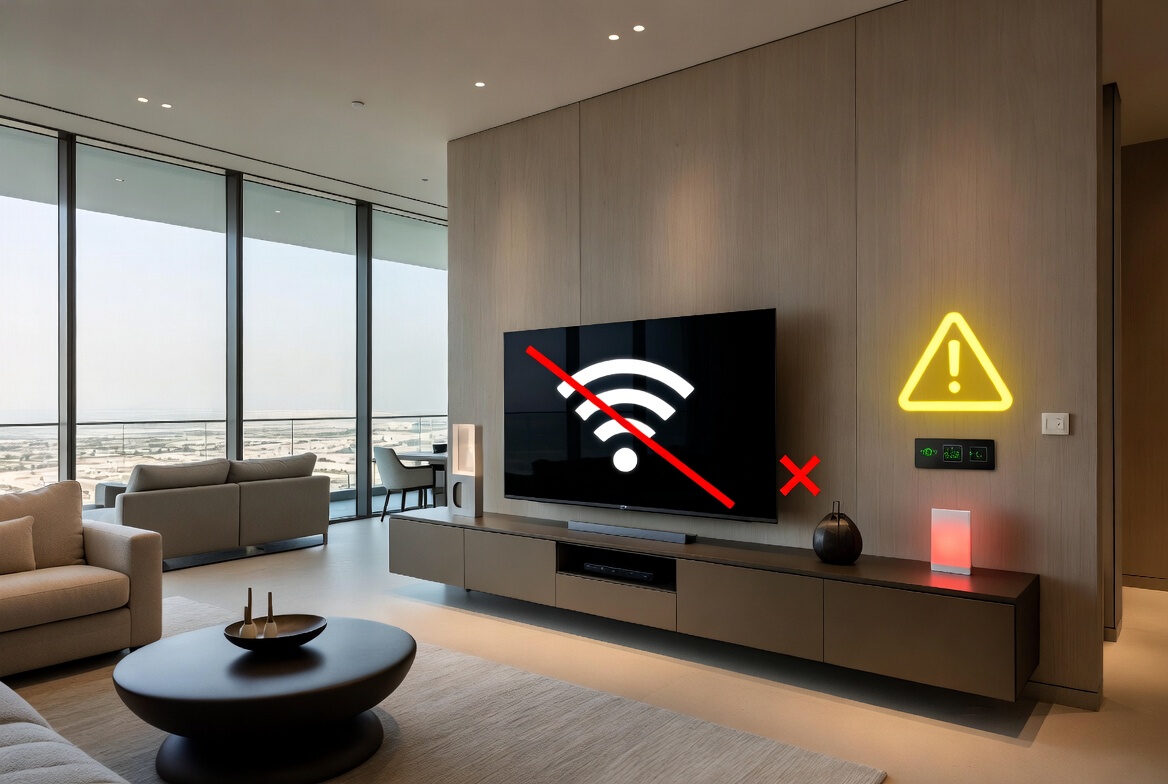
5. Poor Network and Wi-Fi Infrastructure

Smart homes depend heavily on network stability.

Standard home routers are rarely sufficient for Dubai homes, especially villas with thick walls and dozens of connected devices.

A robust network design with proper access point placement, segmentation, and wired connections is essential for a reliable smart home experience.

6. Skipping Professional Installation and System Commissioning

DIY installations often lead to improperly configured systems, security vulnerabilities, and unstable performance.

Professional installation ensures correct device calibration, secure system setup, and thorough testing before handover.

Commissioning is critical to ensure the system performs exactly as intended.

7. Failing to Plan for Future Expansion

Many smart home systems are installed without considering future upgrades or expansion.

In Dubai, where properties often evolve over time, systems must be scalable and flexible.

Choosing platforms that support future technologies and modular expansion protects the long-term value of the investment.

Final Thoughts

A smart home should enhance daily life, not complicate it.

By avoiding these common smart home mistakes, Dubai homeowners can achieve a system that delivers real comfort, efficiency, and long-term value.

Proper planning, professional design, and future-ready technology are the foundation of a truly intelligent home.

Planning a smart home in Dubai?
Avoid common mistakes with expert guidance from Esmartech.
21Dec

Awesome 5 Smart Home Upgrades That Make a Real Luxury Difference in Dubai Homes

by mhd.goudarzi@gmail.com

The 5 Smart Home Upgrades That Make a Real Difference in Dubai Homes


1) Smart climate control that’s designed for UAE weather

If you do only one thing, do this: implement a smart climate strategy.

A high-performing Dubai setup typically includes:

  • Zoned temperature control (especially villas)

  • Scheduling around working hours and weekends

  • Presence-based automation (eco mode when nobody’s home)

  • Remote access for travel

This is where “smart” becomes real: you stop manually adjusting AC and start letting routines handle comfort.

2) Lighting scenes that feel luxury—not “techy”

Luxury smart homes don’t look like gadgets. They feel like design:

  • “Welcome Home” scene: soft lighting + preferred temperature

  • “Movie” scene: dim lights + curtain control (if applicable)

  • “Night” scene: pathway lighting + security arm

Esmartech-style approach: make scenes simple, consistent, and fast—one tap, or fully automated.

3) Door locks + access control with audit trails

Smart locks are now expected in many premium properties. Prioritize:

  • Reliable mechanical + digital fallback

  • Temporary access for guests/housekeeping

  • Time-based permissions

  • Event logs (who entered and when)

For Dubai landlords, this can also improve operational convenience (short lets, staff access, maintenance).

4) Sensors that prevent expensive problems

Small sensors often deliver the highest ROI:

  • Door/window sensors (security + AC efficiency when balcony doors open)

  • Motion sensors (automation triggers + safety)

  • Leak sensors near AC drain lines, kitchens, and washing machines

These are the quiet backbone of an intelligent home: fewer surprises, better control.

5) A single “system design” instead of random devices

Dubai homes often start with a few devices bought online—then the owner gets stuck with:

  • Multiple apps

  • Devices that drop offline

  • Automations that fail at the worst time

A professional smart home design avoids this by choosing:

    • A stable central controller/architecture

    • The right mix of wired + wireless where appropriate

    • A clean handover: scenes, labels, and documentation

Want an Esmartech-style smart home plan for your villa or apartment? Message us and we’ll map the right system (not random devices).

21Dec

Smart Home Dubai 2025: What’s Changing Right Now

by mhd.goudarzi@gmail.com

Discover 2025 smart home trends in Dubai/UAE—Matter interoperability, energy management, and next-gen security. Practical tips from Esmartech

Dubai is moving fast toward a lifestyle where homes are not just connected—but genuinely intelligent. In 2025, the modern “smart home” in the UAE is no longer defined by a few app-controlled lights. It’s defined by interoperability (Matter), energy-aware automation, and security that works reliably—even when you’re away.

If you are searching for smart home Dubai or home automation UAE, this guide brings you the most important current developments and how to apply them in a real home (apartment, villa, or townhouse). It also highlights what Dubai homeowners should prioritize: stable connectivity, efficient cooling control, and privacy-first security.

What’s new right now in smart homes (the news you should know)


1) Matter is making smart homes simpler—and more future-proof

One of the biggest changes in the smart home world is the rise of Matter, a connectivity standard designed to improve compatibility between brands and platforms. Instead of being locked into one ecosystem, homeowners can increasingly choose devices that work together more smoothly.

More importantly for Dubai and the UAE, Matter is expanding into energy-related device categories, enabling smarter energy monitoring and control. Matter 1.4 specifically broadened energy management support for devices such as solar panels, batteries, heat pumps, and water heaters—pushing smart homes toward real, measurable efficiency improvements.

Why this matters in Dubai: cooling is a major energy driver. A home that can coordinate thermostats, occupancy, and schedules—reliably—delivers meaningful comfort and savings.

2) Smart home platforms are now adding deeper compatibility (including cameras)

In practical terms, homeowners want one thing: everything in one app, working consistently. Platforms are racing to support broader device categories. Recent coverage highlighted SmartThings expanding Matter support, and there has been fresh reporting around Matter-compatible camera support—another step toward reducing the “mixed apps” problem.

Takeaway: the market is moving toward fewer compatibility headaches, which makes this a strong time to invest in a structured smart home setup—especially if you plan to stay in the same property for several years.